Uncategorized

Rationalists from India are pro-human, not anti-Hindu!

Are the Indian rationalists anti-Hindu? That would be a silly question from the proclaimed believers, who cannot see reason. Rationalists from India would most likely have been born ‘Hindu’ and would have first hand experienced the practices that are condemnable in a civil society.  This question should perhaps be ignored. However, I see that this is becoming a major propaganda. Of course, rationalist from India are critical about the rituals of Hinduism such as Made snana (1). Religious zealots would justify this and all such inhuman acts in the name of God and salvation. For them keeping the masses brain washed and controlling them is more important and they cannot stand being questioned. Surrender and attain salvation!

Of course, the rationalists from India were against caste based hierarchy, discrimination, untouchability and promote secularism, As Sampath says in an article in The Hindu dated 9th September 2015 ‘the battle for secularism cannot be won without first addressing the reality of caste, for it is the virus behind the pathology of Hindutva’ (2). If you are a rationalist from India, it is but natural that you question the Hindu rituals. If you are an atheist or agnostic, you question all religions. For an independent person like me, I would question anything forced on other people based on some one’s faith. I have written earlier about religion and conversions in my blog.

By some coincidence, there is an article in The Hindu today about one of the eminent neurologist, author Oliver Sacks by the former CBI Director R. K. Raghavan. He quotes a conversation between Oliver Sacks and V. S. Ramachandran, Director of the Centre for Brain Research and Cognition at the University of California, San Diego. Sacks passed away recently and Ramachandran had visited him in person 5 weeks earlier (3).

Sacks: I’ll probably never see you again Rama, have a good life.

VSR: Well, you never know!

Sacks: Well, I am an old Jewish atheist, Rama, but you are right, who knows!

The main point to learn from this conversation is that rationalists and atheists are there all over the world and they have questioned irrational acts of the believers, especially when it is also inhuman.

Over the last two years, M. M. Kalburgi in Dharwad, Govind Pansare in Kohlapur and Narendra Dabolkar in Pune, all rationalists have been murdered by religious terrorists. So far, these terrorists have not been identified. Indian police is certainly capable of getting to the truth. Indian media covered the murder of a 21 year old girl due to family feud and the police acted swiftly, though the murder took place more than 2 years ago. Kalburgi’s murder has not received due attention from the media.

Rationalists from Bangladesh Ananta Bijoy Das, Washiqur Rahman and Avijit Roy were killed by religious terrorists there. I am sure they were not anti-Hindu. In Bangladesh, if you are a rationalist, you would be anti-Muslim. Richard Dawkins, a proclaimed atheists has questioned Christian faith. Wherever you are born, if you are a rationalist and you watch atrocities committed in the name of a religion, you have no choice but to oppose.

Making rationalists from India, anti-Hindu is convenient for the religious bigots. It is easy to make the blind followers hate the rationalists. It is easier to convince the blind followers to murder the rationalists. As some one pointed out, religion can make you hate some one you don’t even know.

I am a Hindu and a rationalist. I have opposed, I oppose and I will oppose any and all inhuman activities promoted in the name of Hindu religion. Any and all caste based discrimination, untouchability and hierarchy will be condemned. Earlier this week, three dalit women were fined for entering a temple in Karnatka. Mumbai has banned the sale of meat as Jains are observing some fast. I condemn them both. Secularism allows you to follow your faith. No one has a right to dictate what others should do. Do not force your morals on others. We have a constitution and we will follow that. Indian rationalists would naturally be anti-Hindu.

  1. https://en.wikipedia.org/wiki/Made_Made_Snana
  2. http://www.thehindu.com/opinion/lead/is-hindu-nationalism-a-viable-project/article7629924.ece?homepage=true
  3. http://www.thehindu.com/opinion/op-ed/neurologist-writer-healer/article7629878.ece?homepage=true
Standard
Uncategorized

Reservation vs merit in India or Affirmative action vs equal opportunity in the USA

When I was 32, I had lived in India for 3/4th of my life and in the USA for the rest of it. Until then, I did not have to worry about the title of this blog. I had qualified in the CEPA (Common examination for post-graduate admission) for my MSc in IIT Madras, GATE for my M.Tech in IIT Delhi and GRE/AGRE/TOEFL/TSE for my Ph. D. at the Kansas State University. My admission was not at the cost of someone more meritorious.

While I did not know much about reservation in India in the early 80s, all the Universities in the USA used to declare themselves as an Equal Opportunity/Affirmative Action Employer. I did not quite understand affirmative action initially and when I did, I realized these two terms contradict each other. I returned to IIT Kanpur at the end of 1994 and moved to IISc Bangalore after 5 semesters. I had to deal with admission of students. Details of “reservation” had to be learned.

Ramalinga Vallalaar, a Tamil saint from 19th Century, said எல்லோரும் எல்லாமும் பெற வேண்டும் (Everyone should get everything). Almost every one would feel benevolent at some time or other and agree with this statement. On the contrary, most would not disagree with a statement “Only those who deserve something should get it”. One could see that both these two philosophies, though contradicting, have some merit in them. One would like to see that every one gets equal opportunity if not everything.

The declaration of independence in the USA (1776 AD) starts with the statement: “We hold it to be self-evident that all men are born equal”. There was no need to offer any proof. One can compare this with what Thiruvalluvar said in Tamil, believed to be more than 2000 years ago: “பிறப்பொக்கும் எல்லா உயிர்க்கும்” By birth all lives are equal. Clearly, Thiruvalluvar was more progressive. Tamils call this ‘Thirukkural’ as their Veda.  Manusastra and Bhagavat Gita talk about ‘varna’ which may have led to the ‘caste’ system in India.

Those who still defend the indefensible ‘caste’ system suggest that the ‘varnas’ don’t depend on birth but on the characteristics of the people. In practice, the birth determined the caste in India and it determined what one could hope to do in life. It did not depend on what one was capable of. So much have been written about caste, today it seems to me that I would not see the abolition of caste in India in my lifetime. Ambedkar must have been day dreaming when he wrote about the ‘Annihilation of castes’ in India.

Today’s Hindu has a good analysis of caste in the urban and rural area ( http://www.thehindu.com/opinion/lead/urban-and-rural-continue-to-be-treated-as-contrasting-categories-in-india/article7248519.ece?homepage=true ). I quote from this article: “He said that the university functions under the pressure of three main lobbies: the Brahmin group, the Thakur group and the Kayastha group. They actively compete for influence over every major decision, and, most avidly, over the process of selection for new appointments.” Clearly, none of this groups worry about merit.

Ekalavya, an important character in Mahabharatham, one of the two great epics from India, teaches himself to become the best archer of his time. He was not born in a family of Kings. He thinks of Drona as his guru.  Though Drona never taught Ekalavya, he could still demand guru dakshina (tuition fees) from the loyal disciple. What does he ask? The thumb in the right hand! Why does he ask? His favourite student Arjuna should remain the best archer. It doesn’t matter if he wasn’t. He was born in the right family. We are taught to celebrate Arjuna and his bravery. Favouritism remains a curse in India even today.

While the forefathers in the USA concluded that ‘All men are born equal’, they clearly had only ‘white men’ in their mind at that time. Slavery was legal. It took the USA nearly another century to abolish slavery. Affirmative action was introduced to help those who have been deprived historically to catch up. Obama could rise to be elected as the President of the USA for two terms! Has Martin Luther King’s dream come true in the USA? The recent killing of African American youths in the USA raise doubts about this.

The forefathers of India had more history to learn then the forefathers of the USA and realized that in practice all were not born equal in India. What Thiruvalluvar said 2000 years ago could not become a fact of life in India, thanks to those who could take power in their hand and ensure that the inequality persisted.  The new and independent nation, India, realized that it is important to undo the wrongs of the past and introduced ‘Reservation’ for the disadvantaged section in education and jobs.

Reservation was of course intended for only a specific period to ensure that the historically marginalized section could rise. With the democracy giving power to unexpected sections since independence, favouritism remains and who is favoured changes with time. Every group that captures power, wants to remove the people who have been appointed due to favouritism and appoints a new set due only to favouritism. I wonder if the vicious cycle would ever end here.

If you had one kid in life, you will see genetics at work at times. If you have two kids, you would realize that genetics is not all. To determine the future of any kid, based on birth is a great injustice. It seems to me that people in India grow up accepting such inequality as matters of fact. Is favouritism bad? Is reservation bad?

There is a proverb in Tamil which points out that the five fingers are all not of the same length. Often it is quoted to highlight the difference between children of the same parents. Most every one today might agree that ‘all children should get the same opportunity’. Clearly, even if all children got equal opportunity, some would grow more than the others. Some are more capable and so they progress better. Should not their children enjoy the fruits of their parents success? Won’t these children be already ahead of the children of those who could not progress as much, even after having equal opportunity?

Blood is thicker than water, more thicker in India than in the USA. It seems to me that, it is the root cause of the problems in India. Often the strength and weakness are the same. Favouritism wins. I hope we can evolve into a society in which the bottom line is redrawn for every generation. May the best lady win.

PS1: I read a comment by Vinod Mehta, published the day after he passed away: “[Bombay] was a wonderful city. A city of gold. You came there, all communities lived there, and the best man won. No caste, no religion. Then Bal Thackeray came and vitiated the whole atmosphere. I saw that in front of my own eyes. The Bombay we knew and the Bombay we loved was destroyed. When Bal Thackeray died, both Arnab Goswami and Rajdeep Sardesai asked me to come on their programmes. I refused. You can’t tell lies on television. And if I had said what I really felt about Bal Thackeray, the studios would have been burned.”

PS2. I read another comment exactly on the same lines but mentioned by an American. The comment said something like ‘your birth is becoming more important in the USA to decide your future’. I could not locate it but the message was the same. USA is considered the land of opportunities where the best person won, irrespective of the background! That did help in making it a land of dream for the world.


Standard
Uncategorized

Business vs public interest. Net neutrality, pizza hut and coffee board

America is still a country of dream for the world. Everyone likes to go there as it is supposed to have an open market and no state control. That, it is not enough for a country was known when the bubble busted in 2008. Perhaps some state control would help as when business interests combine, public interest will take a back seat.

People from India, whether vegetarians or not, initially find it hard to eat out in the U.S.A. Many would have heard an Indian standing in a Burger King counter saying: “One cheese-burger without burger and one coca cola without ice”. All these outlets fill your glass with ice and I wondered if there would be any coca cola in the glass. Though I could handle a burger, I preferred coca cola without ice cubes. It used to be sufficiently cold anyway.

One thing most Indians like the first time they taste is pizza. It can be ‘pure’ vegetarian too. They may use the same knife and spoons, but we are in the U.S.A. We used to have parties at the Chemistry Department at Kansas State, when the students would proudly proclaim: We will have the best food known to mankind: Burgers and hot dogs. Of course, they would not have tasted delicious dosa and ‘parotta-chalna’ on the streets of Madurai. For some reason, I never liked hot dogs but could handle burgers.

I have always been old-fashioned and my taste buds are coarse rather than fine. When I could finally figure out the difference in taste between Pepsi and Coca-Cola, I liked the latter better. Among the pizza, I liked the pan pizzas at Pizza Hut. Only later I found out that the original Italian pizzas are mostly thin crust. I liked it the American way. But, there was one problem.

Manhattan, KS, the little apple has  a pizza hut right next to the University and I learned that it was among the first three Pizza Huts to be opened in the U.S.A. Now, there are three within 3 km of my Institute in Bangalore. When I went to the Pizza Hut the first time, I asked for Coca cola. The waiter told me that they would only serve Pepsi. I really had no-choice in the free market USA. Pepsi and Pizza Hut have a tie-up and so you cannot have Coco Cola with Pizza if you go to Pizza Hut. We started ordering Pizza from the hut and buying coca cola from the local store.

Indian Institute of Science had one of the very few outlets established by the Indian Coffee Board. Coffee at coffee board was a must if one visited IISc, until a few years ago. I happened to be the Amenity Committee Chairman when the coffee board closed door at IISc, despite my best efforts. The employees association was opposing the raise of coffee price from Rs 5 to 6. They wanted it to be Rs. 5.50, when it was becoming difficult to find coins. I allowed the coffee board to increase the price to Rs. 6 and the association ransacked the coffee board outlet. I pleaded with the Administration that the Institute should put the association in place. It was felt that the issue was not important enough to make the association unhappy. The top would say: Why do we need coffee place inside the campus? Association continued but the coffee board closed.

Of course, my main objective in mentioning the coffee-board here is different. We also had a tea-board right next to it though it had nothing to do with the Indian Tea Board. That was run by ex-employees of the coffee board. When the tea-board was allowed to open, a condition was put: As long as the coffee-board works (7 AM – 6 PM), tea board should not sell coffee. I found it strange and announced that we would let tea-board serve coffee all the time they are open. Coffee board objected. I told them that they are welcome to sell tea. They said it was against their policy.

So, here in state-controlled India, the tea-board was prevented from selling coffee. In the free-market USA, business tie-up between Pepsi and pizza hut, prevented the latter from selling coca-cola.

I had not quite followed the ‘net-neutrality debate’ until recently. Clearly, it is the confluence of business interest which removes the choice from the user. I can’t believe that the Government of India wants this to be debated. Public resources cannot be given away to the businesses for exploitation. I signed on the petition recently in change.org to maintain net-neutrality.

Before closing, I must share another experience. When I was in Urbana-Champaign, we organized a lake-Michigan circle tour. We drove two vans around the lake and it was 1100 miles. We stayed in tents at the banks of lake Superior. There is a small island called Mackinac island near Sue St. Marie (http://en.wikipedia.org/wiki/Sault_Ste._Marie,_Ontario). We had lunch at a pizza hut and it served Coca-cola. Apparently the city administration told them: Here no one likes pepsi. If you want to open your outlet, you have to sell coca-cola. Clearly, in a democracy, people’s choice could be enforced if everyone speaks their mind. Here in India, free speech is voluntarily given up by many, either out of fear or for favor.

That really brings me to a close now. I was very pleased to see the recent vocal support for net-neutrality by many professors of IIT and IISc. Finally, have we started speaking up!? http://timesofindia.indiatimes.com/tech/tech-news/IIT-IISc-professors-join-the-fight-for-net-neutrality/articleshow/47024566.cms

Standard
Uncategorized

What, where, and when not to speak!

At times, I am quite surprised at the way, a commoner or a leader in India speaks in public. In Tamil, I have heard it said: இடம் பொருள் ஏவல் அறிந்து பேச வேண்டும் i.e. One should learn to speak what is appropriate based on where one is speaking, who the audience is, what might be understood by what one says.  Often in a conversation between two, what one wants to say, what one actually says and what the other person understands, could all be different.

Not much damage could be done by a private conversation, but speaking in public is different ballgame altogether. For example, I did not find Steve Waugh to be insensitive when he made a joke while commenting on a head injury of a player from England.  Luckily for the injured player, a scan did not find anything serious. Waugh said something like ‘I am not surprised they did not find anything when his head was scanned’. He was joking with his neighbor on the stage. Unfortunately, a mike was on and his comments were heard by many and he was criticized by the media.

In general, those who speak and communicate well, can succeed in what they do. However, in India, it is not always so.  Parochialism, nepotism, and favouritism are common and family connections can become more important than skills.  Rahul Gandhi could not have survived beyond one election in other democracies.  Once I listened to Kanchi Jeyendra Sarawathi swamigal and was distinctly unimpressed! He lacked even elementary public-speaking skills. How on earth was he chosen for a job that needs an ability to communicate well!  Clearly, good orators like our ex PM Vajpayee and ex CM of Tamil Nadu, Karunanithi could do as well in public life in India as the not-so-good Rahul Gandhi or Kanchi swamigal! Historians would have a tough time figuring this out.

For those who can read Tamil, here is an interesting blog on the importance of speech: http://thannambikkai.org/2009/04/01/2332/ .

I have been surprised by what some of our leaders have spoken in public. Our Prime Minister has been criticized for taking potshots at the opposition while on a tour to Canada. I too did not like him making such insensitive comments in an alien country.  As a head of the  nation, on a visit to another country he ought to have shown greater refinement.  It is quite obvious that many of us, including even those who hold high public offices, do not know what to speak in public.

It’s not just in politics. One might see such loose talk by leaders in academic institutions as well.  Present set of leaders may accuse the previous leadership in public, with utter disregard for propriety.  The worst part is that, the allegations could in reality be based on perception rather than fact.  What would be visible is the eagerness to appear like a messiah in public. I was shocked. How do they rise to such positions, when they don’t even know how to talk! Is it insecurity, eagerness to show off in front of anyone and everyone or simple ignorance about how to conduct oneself in public?

I have heard about one of our top scientist talking in front of high school children ridiculing ISRO’s achievements. He had demonstrated a plastic bottle fly off using a controlled explosion and had mentioned: That’s all rocket is, what is great about ISRO? He must have been piqued at or jealous of the ISRO team getting all the attention and recognition for ‘scientific’ achievements, while hardworking scientists, i.e. ones like him, did not. Many ‘real scientists’ get upset when Dr. Abdul Kalam is called a scientist by the mass media. He is a great motivator and science and technology administrator and has richly deserved all the accolades he has received.

I have heard faculty members speaking about their colleagues in a derogatory manner in front of their students in premier institutions in India. This is not something you tell your students. I have not seen such loose talk by faculty members in other parts of the world.

On another occasion, a senior scientist used the scientific session of a national symposium to criticize leaders in front of a large audience from India and abroad. The main objective appeared to be embarrassing the organizers. This could have been done when the national body organizing the symposium was meeting to discuss their activities. Several scientific bodies (s)elect as President some one who has stopped doing research for decades. While the wisdom from the elderly could help any organization, these Presidents insist on giving the first scientific talk. We do not seem to have any problems in embarrassing ourselves in front of an international audience. May be only the audience is embarrassed and the speaker feels proud about wielding power.

When I think about all these talks by the educated elite in premier institutions, what the PM has done in his first year pales in comparison. May be the Indian scientists need to take a clue from what he has done to the elders in his party.

We have not learned to respect positions. We have not learned to question authorities in a proper way, when they do something wrong. I have been wondering! Why do we have such leaders? These misfits feel they have been deprived of their just desserts, even after getting to the top.

I have a lot of hope and confidence in the youth of India. I am certain that they will not emulate their flawed leaders. Wherever you are and whatever you do, in Government or politics or an educational institution or business, be bold and speak your mind because that’s what is expected of you. But when you are talking in public, learn to be respectful; to the opposition, to your colleagues, and to your institution! And when you travel abroad, be mindful of how you project yourself as well as the image of your country, without sounding like a chauvinist. Pride is a virtue, hubris is not.

Acknowledgments: I thank my friends Ravi and Haragopal who went through the rough draft and helped in expressing my thoughts better. However, all the contents reflect the views of the author and any or all shortcomings in the blog are entirely his own.

Standard
Uncategorized

Learning history 3: Birthday, new year and so on

All my official documents indicate that I was born on 11 May 1961, the day that has been declared National Technology Day in 1999 after the ‘Buddha smiled’. India became a nuclear nation and eventually, every nation on the earth had to remove sanctions and start dealing with India (http://www.sac.gov.in/SACSITE/vsse-vyom_files/Page394.htm). Every one knows NPT, non-proliferation treaty, was biased in favor of those who have. When you don’t have, you cannot point it out as it would be considered ‘sour grapes’. I am glad the USA is talking to Iran, despite the opposition from Israel.

I am digressing. I was home-delivered and there is no record of my birth. I am not unusual and it was quite common for people with my back ground. If you ask elders in the family: When was I born? The usual answer would be that year there was flood in Vaigai or there was an earth quake in Gujarat or some such pointer. Who needs more accurate information? You can find many without a birth certificate and our ex PM, Dr. Manmohan Singh was one.

Every society finds some way to keep records, for various lengths of time. If we did not have birth certificate, we would have a ‘horoscope’. And, some radicals come and mess up the system. Periyaar did this in Tamil Nadu. My father was a big follower when he was young and I was born. So no horoscopes were written for any of us. No birth certificate and no horoscope. My existence has been physically verified by many.

Those days, children were sent to school and one test for admission is that the student should be able to touch his/her left ear with the right hand taking it over the head. If you can do this, you are old enough to be admitted. So I was admitted. The school needs a birth date to be put on record. At times, the naive parent/uncle may ask, what date should I tell so that you would admit, we can’t keep him/her at home any more! Most of us have birthdays in May/June. It may be an interesting exercise to find out the distribution of birth dates for people of my age and older in India.

Usually, most don’t loose time because they don’t know their date of birth. One had to be 5 when entering class I. I must have been six and I did not go to kinder garden. (I used to tell my kids when they completed LKG/UKG, you have studied more than I did). I was born on 11 May 1961 and completed my pre-university in 1979 when I was 18. It sounds right today but I had many in my class who were born in 1962.

As my father grew, his views changed and he became very religious and was careful about time. I have heard him saying “நாள் செய்றத நல்லவங்களும் செய்ய முடியாது” What time can do to you, even the good people can’t do for you. The time of your birth, the day and time you get married, get admitted in school, everything will decide your future. It is astrology and action at a distance. Anytime, some physics experiments are reported proving Bell’s inequality, those who believe in astrology would say: I knew it. I am not an expert in astrology, nor do I understand Bell’s inequality clearly. It is related to action at a distance and teleportation and all those sci-fi fancies.  However, I was astonished by the silence among the Indian scientists and academicians when astrology was introduced in curriculum by a previous government.

I am digressing again. My father was pleasantly surprised to find out that his father-in-law, my maternal grand father, had indeed written horoscopes for all of us. He brought the horoscopes for the six of us (four brothers and two sisters) home one day in 1977, if my memory serves me right. I found out that I was born on 7th June 1962. I am not sure if my favorite number became 7 after this or it had been 7 even before this. When I could get a t-shirt with a number printed on the back of it, I asked for 7, even though some one else already had 7 (This was in our research group at Kansas State University). I was pleased to see my favorite player Dhoni wearing 7. I chose 7th November to start my career in IIT Kanpur, which happens to be C. V. Raman’s birthday.

When was I born? I had no clue I would be in Government service in India which would make me retire at a specific age. My real birth day is 13 months later than what was there in my SSLC (Secondary school leaving certificate) book. I assume my horoscope is correct as my grand father had no reason to write a wrong horoscope for me. Both my father and I were worried about my service ending more than a year before it should, some time in a distant future.

We took my horoscope to the Principal of TVS High School and requested him that my date of birth should be changed. We pointed out that my certificate date is less than 10 months after my elder brother’s actual date of birth (We hid the information that he also had a different date of birth and so in either case we would have had enough time in between). The principle showed us a statement signed by my father: All the above information is correct to the best of my knowledge. He also told us about another parent coming with their wedding invitation. The child was born before marriage. It was not possible in the conservative Madurai. The principal refused to change for them and for me.

Many of my facebook friends wish me happy birthday on May 11 and all I can say is: Thank you for your thoughtful wishes. Of course, celebrating birthday was not part of our way of life.  The first time I cut a cake was in Urbana-Champaign when a friend visited us on June 7th with a cake, may be in 1993. In the last few years, my students get me a cake every year on June 7th. My family has been getting me some cake/present… I am thankful to all of them.

Luckily for me, I had a horoscope! When my parents were looking for a girl, they eventually found my wife’s family which also did not believe in horoscopes. In any case, they were more organized. Her grand father had a diary and had written down the date and time of birth. That’s all one needs to get a horoscope from a computer now. I have to be thankful to the stars that our horoscopes matched. When our first child was born in Urbana-Champaign, I was wondering if we should include the time (day light or standard), latitude, longitude and altitude to construct the horoscope. We did manage to get one, just in case!

Today is Tamil New Year’s day. I found facebook postings about whether it should be January 14th (beginning of the month Thai as chosen by the previous Government). Bharathidasan, a great poet and Dravidian idealogue had opined that January 14th is Tamil New Year. There is a proverb in Tamil ‘தை பிறந்தால் வழி பிறக்கும்’. When the month Thai begins, things will get cleared. January 14th is Pongal festival, a farmer’s festival and it is the time for harvest. Today I found one facebook user claiming January 14th is new year for the ‘Dravidian Telugus’ and not for pure Tamils! Wow! How do they come up with such a thought! Telugu New Year is Ugadi which comes towards end of March.

So, here I am. Not certain about my birthday or about new year for my people! However, I can confidently say this year is Thiruvalluvar year 2046 as he was born 31 years before Jesus Christ and so the westerners have a calendar with a smaller year 2015. I can prove it as I found it in the web ( https://venkadesh1987.wordpress.com/2010/08/27/tamil-new-year/ ) Our year is bigger than yours! Three cheers to my Tamil brothers and a very happy new year to all!

Some trivia before ending:

1) Here is a song I loved from Kandiraja drama in the movie Pudhayal. Kandi is a place in Sri Lanka which was part of the 56 kingdoms of India. If you know Tamil, you can listen to this song and find out how peace loving our kingdoms were: http://www.saregama.com/song/kandiraja-therukoothu-part-2_81797 The part 1 has the names of the 56 kingdoms/nations. Indeed difficult to memorize. Part 1 may be accessed by searching Kandiraja in this site)

2) Here is a map of the 56 kingdoms in ancient India. There are plenty of references. http://upload.wikimedia.org/wikipedia/commons/2/21/EpicIndiaCities.jpg (Note added on 6th April 2017. I could not access this wikipedia page but find another blog listing the 56 kingdoms of ancient India: http://theindian-eye.blogspot.in/2012/01/56-kingdoms-of-ancient-india.html I hope it remains available)

Standard
Uncategorized

Learning History II and Happy New Year!

In case you had seen my previous blog on learning history, I have learned ‘the history’ of the song in Parasakthi now. It was indeed written by Udumalai Narayana Kavi. It did involve a detailed investigation before I could reach this fact about something that happened only about 63 years ago (1952). And of course, the first two Departments in the Indian Institute of Science were in chemical and electrical sciences only. I have no idea how that gentleman could have thought about metallurgy. Ignorance or motivated distortion? One  never knows.

Most of you may have received emails or seen facebook postings about how our country (India) never invaded anyone else in the last 5000 or 10000 years. When I saw such news for the first time, I was wondering! Haven’t Chola won the kingdoms all over India. India was supposed to have had 56 kingdoms. You can look at the Wikipedia pages on Rajendra Chola and 56 kingdoms of ancient India. I know one old Tamil song by T. M. Soundarajan (play back for Sivaji Ganesan) in which he lists down the 56 names. I could never memorize that one. Rajendra Chola not only won over many kingdoms in India, he invaded Sri Lanka, Indonesia, Thailand and Malaysia. His history was taught in Tamil Nadu.

Why do we have such proud message from the patriots of new India spreading? I had the first clue when I went to Manhattan KS for doing my Ph. D. One day, I met a man who was originally from India and had settled down in Manhattan. Our meeting was brief and it was a one-off chance meeting. That person started talking to me in Hindi and I told him: Pardon me, I don’t follow Hindi that well. He was visibly shocked. How can you be an Indian without knowing Hindi? I told him that I was born and lived in Tamil Nadu and had learned only Tamil and English. He said: No wonder, south Indians never fought for freedom and that is why you have grown like this. Clearly he had not learned any history of Tamil Nadu or south India. I could only laugh at his ignorance.

While I did learn history of most parts of India and the world, I was wondering if the students from North India learn any history of south India. Recently, some patriotic groups have started talking about Rajendra Chola. In my school days, the Chola kingdom was covered in the History books in detail and I have learned of Rajendra Chola as ‘Gangai Kondaan (the man who won over the nations around Ganges) and ‘Kadaram kondan’ (the man who won over Kedah kingdom in Malysia).  I would have never thought of India as a country that never invaded any other country. I wonder, then, how do so many ‘Indians’ spread this obviously wrong message? Some may really be ignorant and others must be wilfully deceiving themselves and the gullible ones.

Rajaji was the first Indian Governor General of India. Chidambaram Pillai was the first person to own a ship and was running an Indian shipping company standing up to the British. Thiruppur Kumaran lost his life trying to save the Indian flag during the freedom movement. Bharahiyaar’s national songs were so inspirational. I am convinced that he is no less a poet than any Nobel literary winner. He wrote mostly in Tamil. The ‘Indian’ guy who I met in Manhattan KS would have never learned of them as he told me so confidently ‘south Indians did not fight for freedom’. Of course, there were so many more freedom fighters in all the four states (and Pondicherry) from the south of India.

My life has taken me to places I would have never imagined until I was about to complete my MSc in IIT Madras. After my studies in the USA, I returned to Kanpur to take up my first job. One day, when I was roaming around the city, I  found a restaurant. It had a board displaying the menu available: Indian, South Indian, Chinese and Continental! It was in 1995 and I was amused. How can they serve Indian and then south Indian, when we have one India? About twenty years later, I went to Haridwar for a meeting and I found the same menu written in big letters. It seems like finally some national organizations have woken up and realized the problem. Rajendra Chola’s 1000th year is being celebrated and more Indians may have heard about him today. Patriotic north is beginning to learn about the south that did not fight for independence!

14102014028 (Photo taken with my Nokia E72 in October 2014 at Haridwar)

I had not learned much about the northeastern states in India until recently. Thanks to my professional travel and some students here, I am learning a few things about the seven sisters, as the seven northeastern states are called. It was interesting recently to find out that the New Years day, I mean the first of January, is a holiday in only 7 states of India. Six from the northeast except Assam and Tamil Nadu. Look at the following website. I accessed it on 11th April 2015. http://www.officeholidays.com/countries/india/

Of course, we have many other new year’s day and ours is approaching. The 14th of April. The previous Government in Tamil Nadu wanted to change it to January 14th and the present Government must have changed it back to April 14th again. This need not be out of any conviction but the previous Government’s action must be undone. I knew it as new year for Tamil Nadu and Kerala and later on found out that it is new year for Assam and Orissa as well. New year in my current domicile, Karnataka comes towards the end of March and is called Ugadi.  That is new year in Karnataka, Andra and Telengana, and Maharashtra.

Some from the northeastern states do have distinctly different, shall I say ‘oriental’ look. I learned from a friend recently that yellow and brown were added to the vocabulary of the colors of people when some Indians in UK did not want to be grouped with the blacks. Michael Jackson perhaps worried mostly about black and white people and wrote the hit song ‘It  ain’t matter if you are balck or white’. He had, of course, included the brown and yellow people in the beautiful video.

If I am not mistaken, Deve Gowda was the first prime minister of India to visit the northeastern states. Now the nationalists seem to have realized the importance of integrating the northeastern states. Pandit Nehru proclaimed when India got Independence: Unity in diversity. It seems to me that he knew India well. Anyone who does not respect the diversity of India, will most likely come up with a cooked up history. This will make the logical minds laugh and others (blinded by patriotism) raise their head with pride. Clearly the Aryans never invaded India.

I end this blog by wishing every one a very happy new year, irrespective of when you celebrate your new year. We celebrate this year on the 14th of April. Though the Tamil food of Idli and Dosa remain ‘south Indian’ in all the Indian restaurants up north, the Tamil New Year has become a national holiday in India. No India did not do it to unite all the states. For this, we need to thank Ambedkar, the architect of our constitution. He was born on this day! Boy, am I not glad it was Ambedkar who wrote the constitution of India!

Standard
Uncategorized

Learning History

“Those who fail to learn from history are doomed to repeat it!” It was an interesting exercise to find out who said it first as there are various versions.  (https://answers.yahoo.com/question/index?qid=20080825183900AACAIkV This and other web references accessed on 2 April 2015. It credits George Santayana, a Spanish philosopher). Learning from history is as important as it is difficult for many reasons.

One obvious reason is that learning by reading is much less efficient than learning by experience. Most every one ends up repeating history and (re)learning. May be it is better that way, as even as the 7th billion person in the current world, one has to live the life one had no choice of getting. There may really be nothing more to do other than repeating what someone has done and fail/succeed.

One often hears the quote ‘History is written by the victors’ attributed to Winston Churchill. According to the website http://history.stackexchange.com/questions/5597/is-history-always-written-by-the-victors “History is written by victors” may itself be an example of history written by the losers! While the quote is commonly mis-attributed to Winston Churchill, it’s origins are unknown!” I really do not know the history of these statements.

Let me tell you about two things that I know for sure. Indian Institute of Science was the result of a dream by J N Tata and this was influenced by the inspirational dialog he had with Swami Vivekananda on a ship. We celebrated the centenary over a whole year during 2008-09. In 2011, we started an undergraduate programme for the first time, 100 years after we started admitting students. The first batch was admitted in 1911. Clearly the students admitted in 2011 are the 101st batch and not the 100th batch!

While only some can create history, every one would like to have their name etched in history. I have been part of the Inorganic and Physical Chemistry Department at the Indian Institute of Science from May 29, 1997. I learned that this was the first Department to be started by the founder Director Morris Travers who happened to be a Chemist as well.  Interested readers may go through an article I wrote in Resonance about Travers’ contribution to the discovery of Noble gases. (http://www.ias.ac.in/resonance/Volumes/14/12/1210-1222.pdf) Another Department on Electrical sciences also began and these were the only two Departments initially.

I recently found a discussion in Linkedin about the History of Indian Institute of Science started by Chief Engineer at TRIAD OMAN CONSULTANTS INTL.  I had not known him personally but somehow was in the circle. He claimed that “Soil Mechanics and Metallurgy were the First Departments to be Set-up.” I had put a comment pointing out the mistake but then there were 100s of comments applauding the authors for the interesting information and one is not clear if all the readers would go through all the comments to find out the truth. I get messages from Linkedin for more than two years about people still reading this piece.

There is a book about the History of Indian Institute of Science written by Subbarayappa titled ‘In pursuit of excellence’. http://www.amazon.in/In-Pursuit-Excellence-History-Institute/dp/0074624504.  I have heard from our former Director Prof. P. Balaram that there are some inaccuracies in the book though it does give the first two Departments as chemical and electrical sciences accurately. I have witnessed some attempts in the recent years to take credit away from some and attribute credits wrongly to others in the campus.  One cannot take anything and everything that is written on paper or even on stone, on face value. One need not mention about the accuracy of what is found on the web, which is readily accessible anywhere and everywhere now.

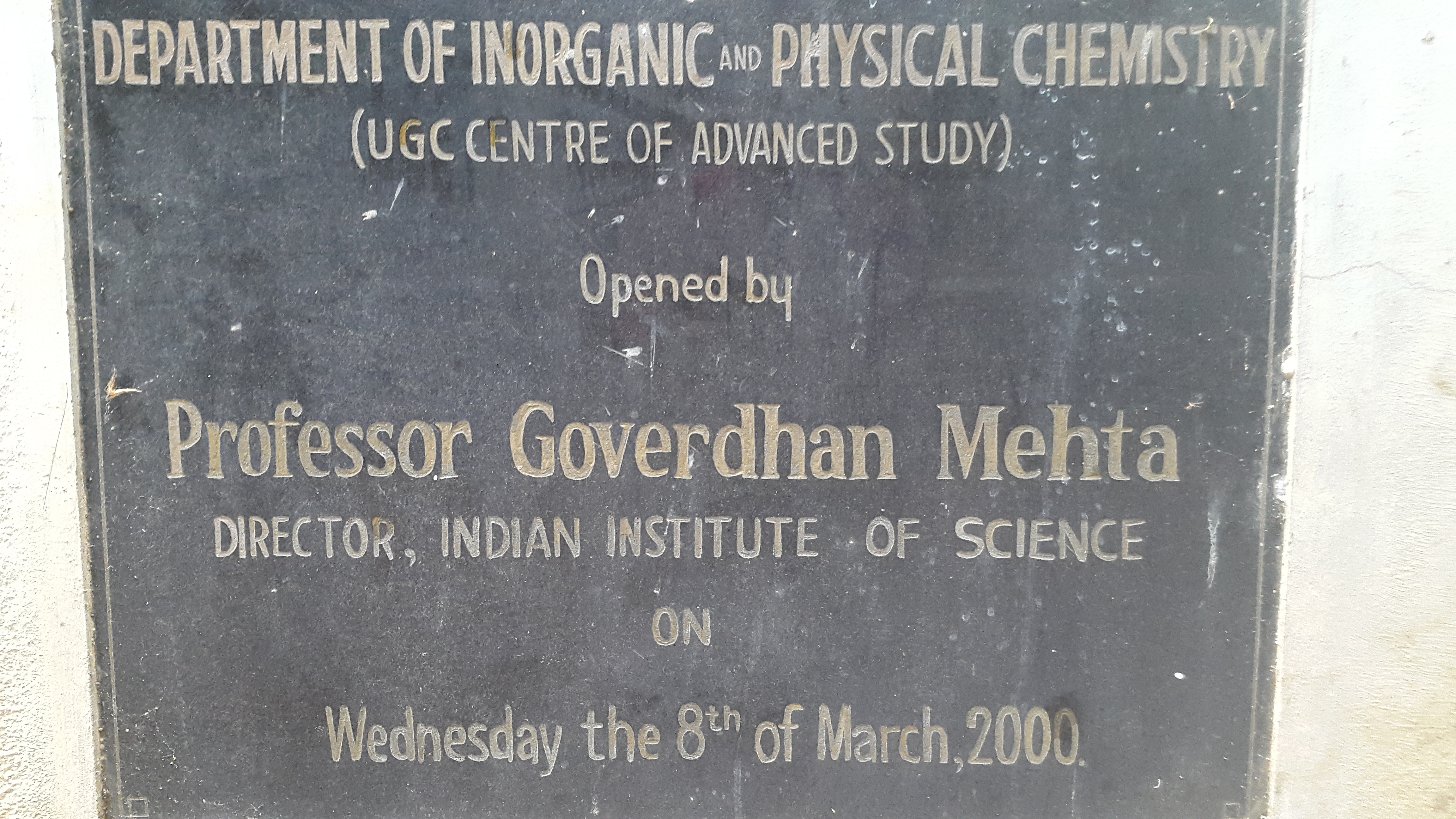
Around 2000, I got a newly built laboratory to house the new spectrometer that we built. Almost a century old Department got four new laboratories built thanks to some funds that came from the Central Government. Of course, it was decided that the Director would inaugurate the new lab.  The estate office arranged for a stone with the name of the Director and the date of the Inauguration and most of us participated in the inauguration without taking it too seriously.  Around 1991, two other laboratories were inaugurated and the information was carved on stone. You can see the information written on stone:

238 239

According to these two stones, Department of Inorganic and Physical Chemistry was opened by Prof. C. N. R. Rao on 27th February 1991 and by Prof. Goverdhan Mehta on 8th March 2000. It did not occur to any one involved, including me, to suggest that the stone should mention ‘This laboratory for IPC Department was opened by’. What  more evidence does one need than what is carved on a stone! In another 100 years from now, two historians may be arguing with solid evidence that Chemistry Department was not the first one and Subbarayappa had his facts wrong. If the Linkein discussion would still be available that would establish soil mechanics and metallurgy as the first Departments and these two stones can give the date of Chemistry Department within two decades, but certainly not in 1911! May be some one changed 1991 to 1911 by mistake and that mistake was carried through 🙂

Somewhat coincidentally after witnessing the way politicians, scientists and of course every one else getting influenced by money, I was reminded of the beautiful song in Parasakthi, the first movie of Sivaji Ganesan who might be considered the best actor in 20th century Tamil Cinema by many. The song is ‘Desam gnanam kalvi easan poojai ellaam kasu mun sellathadi “தேசம் ஞானம் கல்வி ஈசன் பூஜை எல்லாம் காசு  முன் செல்லாதடி”. It means, ‘the nation, wisdom, education, God, praying rituals would all be secondary to money’ and it is a great song. I thought it was written by M. Karunanidhi who became the Chief Minister of Tamil Nadu and popularly known as Kalaingnar Karunanidhi and Mu Ka. He also had written the story and dialogue for this movie and it became a cult classic. Mu Ka is still alive and active in politics and is close to his 90s.

I mentioned this song to some one when I heard about the central Governments decision to withdraw pictorial warnings about the dangers of cigarette smoking. A committee had concluded that ‘no study on Indians has found the correlation between cigarette and cancer’. One does not know if we should laugh or cry. The greatest book on cancer, “The emperor of all maladies” was written by Siddarth Mukherjee, a person of Indian origin. A real scholarly work and a must read for every one including our law makers. Of course, their main concern is the tobacco companies and money. How can one run a party without money. So, I was reminded of this beautiful song. And that brings me back to History. One of my friend contradicted me and said this song was written by Udumalai Naryana Kavi. I was almost convinced of my memory and I checked with my elder brother who is knowledgeable as well and he confirmed it.

I thought I would check on google as it is widely known to be aware of everything. I found the song in YouTube and it did not have the lyricist’s name. It had the names of the singer (C. S. Jayaraman)  and composer (R. Sudarshanam). Then I found the website, http://www.thamizhisai.com/tamil-cinema/tamil-cinema-001/parasakthi/desam-gnanam.php and it gives the Tamil lyrics in full but gives the singer’s name as Chandrababu! This is certainly wrong and appalling to me. It has the composer’s name correct but the lyricist’s name as Bharathidasan. It cannot be correct either.

And then I found another site, http://www.lyricaldelights.com/2012/03/24/parasakthi-desam-gnanam-kalvi-eesan-poosai-ellaam/. This has the song in Tamil, transliteration in English and also a good translation in English. While most of the information is correct, it also has the lyricist name wrong in my opinion. It gives the name as Kannadasan, perhaps the most popular lyricist in Tamil cinema during the 20th century.

So much for learning the history of recent events! Buddha seems to have mentioned: Three things cannot be hidden for long: The sun, the moon and the truth! (http://www.brainyquote.com/quotes/quotes/b/buddha133884.html) While I am convinced about the sun and moon and would very much like it to be true for ‘truth’, how can we ever be sure. No wonder, Thiruvalluvar said this ‘எப்பொருள் யார்யார்  வாய்கேட்பினும் அப்பொருள்  மெய்பொருள் காண்பது அறிவு ‘ Irrespective of what you hear, and irrespective of who you hear from, you need to use your intelligence to see the truth’.

Standard
Uncategorized

Building institutions vs promoting individuals!

Two things that have occupied the media attention in India now are reinforcing a major problem we are facing. One has given positive signs and the other negative signs. Cricket world cup and the Aam Aadmi Party. Strangely, Indians are fond of characterizing the western world as selfish and the eastern philosophy as spiritual. Not surprisingly, the selfist west has produced institutions when India ended up promoting individuals. When one individual disappears, we wait for another individual to rise to the occasion. Rarely are they produced in a system.

I must congratulate Team India for a fantastic show in the world cup until the semi-finals. It was unusual for an Indian team to have not many in the list of top batsmen and bowlers but have a 7-0 record. Dhoni has proved to be a great leader who kept emphasizing about the process being more important than results. Team is more important than individuals. Though, I would have loved to have seen him defending the world cup in Australia, my admiration for Dhoni has gone up.

One thing I have noted all over India. Most of the people are not comfortable standing and talking as equals. They are either on your head or at your feat. I have heard from a retired Professor who had done well in India. This story was unbelievable. All through his career, his adviser was active and he could never do anything on his own. If he wanted to try something new, he had to go to his boss and say: ‘Sir, do you remember, we were discussing this last week and you told me that I should try this experiment’. The boss would say: Did I? yeah I must have, go ahead and try!’. If he ever started telling the boss that he thought about an idea and wanted to try, the response would be ‘Don’t waste your time, do what I say’. Independence was not encouraged even in scientific pursuit!

We were used to glorifying individuals at the cost of teams. Though, one cannot fault Sachin Tendulkar for his brilliance as a batsman, I used to be annoyed listening to Gavaskar and Sastry from commentary box when Tendulkar was close to a century. ‘He should be given some time to score that 100’ was the standard remark. In the process, a crucial number of balls would be wasted and India might end up loosing the game.

I remember when Tendulkar became the first person to score a 200 in one-day cricket. Luckily for him and India, Dhoni was in the other end and he kept scoring at a brisk rate. From commentary box, I heard comments like ‘Dhoni should give the strike to Sachin’ as Dhoni was not giving as often as the commentator wanted. Of course Sachin was tired too and was enjoying Dhoni’s game from the other end. Dhoni ensured that Sachin got just enough balls for him to get a 200 and still India got 420+. India won the game hands down.

Once BCCI organized a special test match for Sachin to get his 100th hundred in Bombay and arranged for a flat pitch. Sachin got out in his 90s. Ashwin as a bowler was very unhappy with the pitch and commented: Anyone can score a 100 in this pitch. The next day he did. If only the nation and the enthusiastic supporters were not so keen on seeing the 100th hundred and kept talking about it, Sachin may have scored that much earlier and a few more 100s.

Aam Aadmi Party had raised the aspirations of the masses like never before in my experience. I am worried about the way the party is becoming centralized. One is not surprised by the way BJP is rallying behind Modi or most other political parties rallying behind their ‘supreme’ leaders. After all ‘India was Indira and Indira was India’. I am reminded of a cartoon in Dinamani, a Tamil Newspaper. Rahul Gandhi stands next to a board with marks written and the few eminent men read: UP 7 on 70, MP 4 on 40, Bihar 2 on 50 (these numbers are not accurate but they tell you the story). They conclude: brilliant boy, he must be asked to lead the parliament election!

Tamil Nadu saw a great movement which was called the ‘self-respect movement’. ‘No one should fall on any one’s feet’ was the mantra. The political parties borne out of this movement are unable to produce successive leaders. A party which came to power with slogans like ‘Why should a carpenter’s son become a carpenter’ seems thrilled with the possibility of having CM’s son as CM, and MLA’s son as MLA and so on. Another party has a leader who cannot stand another person sitting on the dais! The next leader either raises from the ash on their own or pushed by the parents. We cannot have a system in which the leaders of the future grow through the rank due to their merit!

AAP looked different from day one. Now we see individual aspirations affecting the functioning of this party. When two founder members are thrown out because of a significant majority vote, AAP cannot be accused of not being democratic! However something is clearly missing.

I have not watched cartoon movies from Hollywood much until our daughters grew up. One day I took them to Lion King! The first scene stays etched in mind. A monkey as midwife helps the lioness deliver a cub. Monkey brings the cub out and raises it from top of a rock! All the animals shout and scream and rejoice: ‘The King is born’. It seems to me that most of us have not evolved from that stage. There is still hope, as some feel cricket is a religion in India. Will we learn to put team ahead of individuals?

Standard
Uncategorized

Is it Kaliyuga finally or the more things change the more they remain the same!

When I was young, I used to hear many stories from elders, read a lot of Tamil novels and watched a lot of Tamil movies. One thing was common in all these: In the end all good people had all their problems solved and the bad people were either killed or reformed. The good and bad were always clearly defined and there was never any doubt. All those living at the end, lived happily ever after.Thinking back, it was clearly not realistic.

As I have grown to be on the wrong side of 50 now, It is difficult for me to believe that the people were actually very different from the people we are today. However the stories that I was aware of largely ended this way. I am now wondering if there was an unwritten rule that every writer followed. Stories are supposed to motivate everyone and you cannot have a bad person winning in the end. Perhaps, I was not well read and there were realistic stories that I was not aware off.

Then I read a novel by G. Nagarajan ‘நாளை மற்றுமொரு நாளே (Tomorrow is just another day). This novel described one day in the life of a person who is born poor and is not certain if there would be breakfast. It was disturbing but one can sympathize with the hero. I watched Jayakandan’s ‘யாருக்காக அழுதான்’ (For whom did he cry?). It was a beautiful movie with the famous comedian Nagesh as the hero. He comes as a room boy who is accused of stealing a golden chain from a lady staying in the hotel room. There was no evidence but there was no need for any evidence. Who else but the poor room boy could have taken the golden chain? Everyone asks him, threatens him, beats him and he replies them all with a smiling face: I did not take that chain. In the end, the lady finds it safely in her possession but had forgotten. She says sorry and then he starts crying. There are stereotypes here but a bad man does not still win in the end.

Recently, I watched the Hollywood blockbuster King Kong. A ruthless, money minded movie maker cheats a whole lot of people, takes them to an island to shoot a film against their wish. He finds the giant chimpanzee, King Kong and all kinds of deadly animals. Many of his crew die in this adventure and the King Kong and the heroine become unlikely friends. He manages to capture King Kong and brings it to New York to be displayed in a show. King Kong tries to get out, destroys some parts of the city and is finally killed despite the best efforts of the heroine. The movie shows the ruthless man watching the body and walking away. No remorse, no punishment and life goes on for him. I did not feel good.

One of the super hits of Amitabh Bacchan from the 1980s was Don and Rajni Kant made it in Tamil as Billa. A villager looks like a lawless Don and they both end up in an hospital simultaneously. The don dies. The villager goes to the mafia in disguise and eventually helps the police win the mafia. These movies were remade recently in Hindi with Shah Rukh Khan and Tamil with Ajith as heroes. While the Tamil movie did not change the story line, the Hindi movie made a dramatic twist. The don survives and the villager dies. May be more realistic? In the end he cheats the police and everyone else to survive and live happily ever after. It did not feel good.

Tamil movies in the recent years have several talented new comers who make brilliant films. One such movie is சூது கவ்வும் (Evil engulfs). I thoroughly enjoyed this movie which could best be described as ‘irreverence at its best’ (One of my cousin had probably used ‘irreverence’ to describe this movie earlier). This is satirical and describes the story of some small time kidnappers who try to pull off a big one and get caught. In the end, an honest politician (who is not smart enough to make money) is replaced by his son who makes money happily ever after. It should have been as upsetting to me as King Kong and the Hindi remake of Don but may be as it was satirical, it did not feel that bad.

World has perhaps always had good, bad and ugly people. Some good ones may have lost and some bad ones may have won, temporarily or may be eventually. I am just wondering. Are stories in which the bad man wins in the end, are they new today? Were there stories in the past in which the bad man wins in the end without any remorse? Have we come to Kaliyuga, which is described as the end of one cycle in Hindu philosophy, if not the end of the world!

PS. Varnakuzhappam (racial mixing) is supposed to precede this end and that I can see happening. However, I personally feel racial mixing is for the good. Much of Europe today has citizens who are mix, half French, quarter German and quarter Polish and so on! May be such mixing of population between states of India would help India too! or is my thinking influenced by the Kaliyuga and we are really heading towards the end. I believe not.

Standard
Uncategorized

Life of a girl/woman in India, and the World!

The documentary ‘India’s daughter’ is being banned by India and I think it is a terrible idea. It is high time, we look at the way we treat woman in our society and change our ways. It seems to me that the compelling reason for the ban was to stop the west from defaming India. There is really no substance in this argument. The Director has explained adequately and the parents of Nirbhaya have seen the movie and they were moved.

Every society that I have interacted with, has been patriarchal and remain so as of now. Historically, this could have been due to the biological fact that men are physically stronger than women and are expected to protect the family, mostly from other men and occasionally from nature and animals. It is perhaps changing at different paces all over the world. I have travelled extensively in many parts of the world and lived in South and North India and Midwest USA for more than a few years. Western world seems to have changed sooner than the east. South India has changed more than the north. However, these generalizations are no guaranty that women are safe from patriarchal men anywhere in the world.

Our Ramayana portrays Rama as the ultimate king who sentences his own wife Sita and sends her out with two young kids as the Queen should be above suspicion. Rama knows she is not guilty. There was no need to prove the guilt in a court beyond reasonable doubt. After all, Rama won her in an open competition and Sita never had a choice. The values were indeed different at that time and I am not pointing this out to pass judgements. That was the way of life as described and she did not complain. Even in modern law, I am not sure if anyone can be prosecuted, unless the victim or someone else complains. Now even a Prime Minister or President can be taken to court unlike in the days of Rama.

Before, I give some more examples from Indian history/mythology, I should recollect the autobiography of a successful physical chemistry professor from the USA, which was published in 2014. He mentions about his mother, who was expected to be a housewife in 20th century USA. Order in society is helpful if everyone is respected, knows their duty and does their part. That would be an ideal situation which is just not practical. We do need a rule of law which ensures that everyone is treated with dignity and respect.

I remember two of the successful movies in Tamil, Thaen Nilavu (Honey Moon) and Uyarntha Manithan (Honourable man). In the former, a greedy husband attempts to kill a wife. The wife is saved by some tribals. The husband is tried in a court for murdering his wife. In the climax, she shows up in the court and tells that the husband was innocent. I was shocked. The movie of course shows the husband to be remorseful and they live happily ever after. All is well.

In the later movie, a rich lad loves a poor girl from a village. His father does not like it and arranges for her to be burned alive in her hut. Later on, the lad agrees to marry a girl found by the father and leads a normal life, once in a while saddened by the past. I was at a loss to figure out how this title hero is called The Honourable Man! The movie does not show anything about this crime. No complaints, cases, sentences, no nothing. The poor girl’s fate she loved a man she cannot afford and paid the price.

When I was in the USA, I saw a Japanese movie by chance, Tampapo. The movie is largely about Japanese way of life and eating noodles. It did not have a major story line but shows several incidents. One of the incident was stuck in my memory. A husband, working in an industry has a phone call from home. He is informed that the wife is unwell and he should reach home soon. He rushes home in Tokyo traffic. He sees the wife lying down in the hall and two kids sitting next to her and staring at her. He tells his wife: ‘But, we haven’t had our dinner yet!’ The wife manages to get up, go to the kitchen and fix their dinner and falls down dead! Movie goes on to show something else in the next scene.

I have heard numerous stories from the mythology, some of them became movies, about dutiful wives. One such heroines was ‘Sati Anasuya’. She was the greatest of all dutiful wives. She carries her husband, who could barely walk, to a prostitute. The husband was not just able to walk but otherwise fit. He wants to visit the prostitute and his desire is his wife’s command. You see now. Men being physically stronger than women may have led to this arrangement of convenience all over the world. However, thanks to the laws or customs that developed, even in this case, the wife has to not only obey the husband but carry him too.

We have several old Tamil movies with titles which can be loosely translated as: ‘The husband is the only asset for a wife’ (மணாளனே மங்கையின் பாக்கியம்), ‘Husband is the most revered God’ (கணவனே கண் கண்ட தெய்வம்). We have proverbs in Tamil which tells the girls from a very young age: ‘Even if it is a stone, it is your husband; even if it is a grass he is your life-partner’ (கல்லானாலும் கணவன் புல்லானாலும் புருஷன்). We have proverbs favouring a boy over girl: ‘Even if he is short, he is a boy’! How can we stop using ‘proverbs’? Can these be banned?

Thirukkural, which I admire for the most has one Kural often quoted to tell women how to behave: When the wife, who does not pray to God but treats her husband as God, asks for rain, it will start raining (தெய்வம் தொழாள் தன்கணவன் தொழுதெழுவாள் பெய்யெனப் பெய்யும் மழை). In a way, the dependence on the unpredictable monsoon could very well explain the fatalistic attitude that is prevalent among ourselves.

If all these sound like tales from a distant past, we do have some in India living today in that past. This has no doubt led to a conflict between those who want to break away from the shackles and those who feel secure in the confinement. I only hope everyone realizes the importance of treating all human beings with dignity and respect.

Standard