
On this 2nd October 2025, Gandhi Jayanti (birth anniversary), I am trying to remember these three men who had enormous influence in the World. Not just in world politics but also in influencing the masses. I had written a blog earlier about Gandhi’s visit to IISc on 12 July 1927 (1).
I am very active in Facebook and have posted my views on everything that interests me now and then. I watched the movie “American Sniper” directed by Clint Eastwood and released in 2014, recently during a long flight. The sniper (Chris Kyle, performed by Bradley Cooper) says once: An eye for an eye! I was reminded of one of the famous quote by Gandhi: Eye for an eye will make the whole world blind. I posted about this after returning from the trip. Apparently, it is an age-old concept and appears in the book of Exodus in Bible, Old Testament (Exodus 21:24) according to a Google search enabled by AI today. Humanity has been discussing about crime and punishment since we started living as a society. One of the successful movies of Director Shankar, Anniyan, lists out punishments for some crimes from Garudapuranam and it was horrifying. Nassim Nicholas Taleb discusses evolution of moral symmetry in his popular book “Skin in the Game” (2). He talks about silver rule (Do not treat others the way you would not like them to treat you) and golden rule (Treat others the way you would like them to treat you) and says silver rule is better. He points out that the silver rule tells you to mind your own business and not decide what is good for others. I see this in the life of Mohandas Karamchand Gandhi, who became known as Mahatma Gandhi (Mahatma meaning a great soul).
Mohandas was born in a well-to-do family in Porbandar, Gujarat. As a child, he had read the story of Harishchnadra, who would always speak the truth without worrying about the consequences. He trained as a Lawyer at the Inner Temple in London and started practicing law when he was 22. Clearly, he was not an activist yet. After 2 years of not so successful practice in India, he went to South Africa to represent an Indian merchant in a lawsuit. He lived in South Africa for 21 years. His life in South Africa transformed him completely and he became a civil-rights activist. While traveling in First Class in a train, he was thrown out of the train as First Class was only for the Whites. Most humans, irrespective of their space and time, may have felt discriminated at some point in time in their life. Rarely, any of them recognize that they may have discriminated others in other circumstances. Gandhi was different. He immediately realized that people were discriminated in India based on caste and we had untouchability practiced at that time. He followed the silver rule quoted above. He chose non-violent means to fight for the rights of every human being. His autorbiography was titled ‘Experiments with Truth’ and he embodied truth and non-violence. He returned to India in 1915 and led the freedom movement and is widely considered the Father of Nation in India. Even today, I see a lot of people who are convinced that they should be treated well even while treating fellow citizens with contempt. Ironically, some of them now call Gandhi a hypocrite.
While on a visit to the Indian Institute of Science, he pointed out that the 30 Lakhs donated by Tata and also the generous contributions from the Mysore King, both originated from the same labour of the poor millions! He accused the elites of taking the poor for granted and acting as if ‘they knew what is good for everyone’. One can see why Taleb preferred silver rule to the golden rule. Gandhi wanted all the research efforts to have the welfare of the poor as the main objective. As I mentioned in my blog, I do not really agree with this as a true scientist has to pursue research in search of truth, which Gandhi wanted to represent. The outcome may or maynot benefit the poor immediately or eventually. He said ‘No taxation without representation’ and that is the Skin in the Game given as title by Taleb. I read about the shut down of the US Government which would affect every Government employee, except the ones in Congress and Senate and all those directly involved in the Government. All these law makers have exempted themselves from any such shutdown that would affect salary disbursement to the employees. Clearly, they have no skin in their game. Gandhi did. He influenced the world population significantly. Einstein once remarked: “Generations to come will scarce believe that such a one as this ever in flesh and blood walked upon this earth”.
Among the leaders who were significantly influenced by Gandhi are Martin Luther King, the civil rights activist from USA and Nelson Mandela from South Africa. Decades after Gandhi left South Africa, the native africans were exploited by the White settlers. Eventually, the whole world boycotted South Africa and apertheid was lifted and democracy born. Nelson Mandela was in prison for three decades. He was released and won the election to become the President of South Africa. He once remarked: If you want to make peace with your enemy, he becomes your friend. It would have been easier for him to arrest everyone who was responsible for prisoning him and put them in prision. Eye for an eye. Real leaders want everyone to grow together. Clint Eastwood made another great film on Mandela titled ‘Invictus’ with Morgan Freeman portraying Mandela. Despite the uneasy relationship with the White settlers and the native Africans based on mutual lack of trust and respect, Mandela realized the importance of building trust and respect. He also realized the importance of sport and discussed with the White captain of Rugby team Francois Pienaar, played by Matt Daemon and supported them to win the World cup. Mandela’s objective is peaceful coexistence and progress and was never divisive.
Martin Luther King was influenced by Gandhi and led a non-violent movement to end civil discrimination in the US. Though slavery was abolished by Lincoln in the 19th century, discrimination of the native americans and african americans continued until the 1960s. I had written a blog about Rosa Parks, who was asked to vacate a seat in the bus for a white man earlier (3). When a White law maker reminded King that no law will make a white man love a black man, King responded: I want a law that will forbid the White man from beating up a black man. He was particular about the well-being of all his followers. During a march for voting rights from Selma to Montgomery, with a brutal police force awaiting them, King called off the march and returned. His followers were upset, angry and confused. He abandoned the march as he feared for violence and loss of lives. He eventually succeeded in his attempts to get voting rights for every citizen through legal and non-violent means.
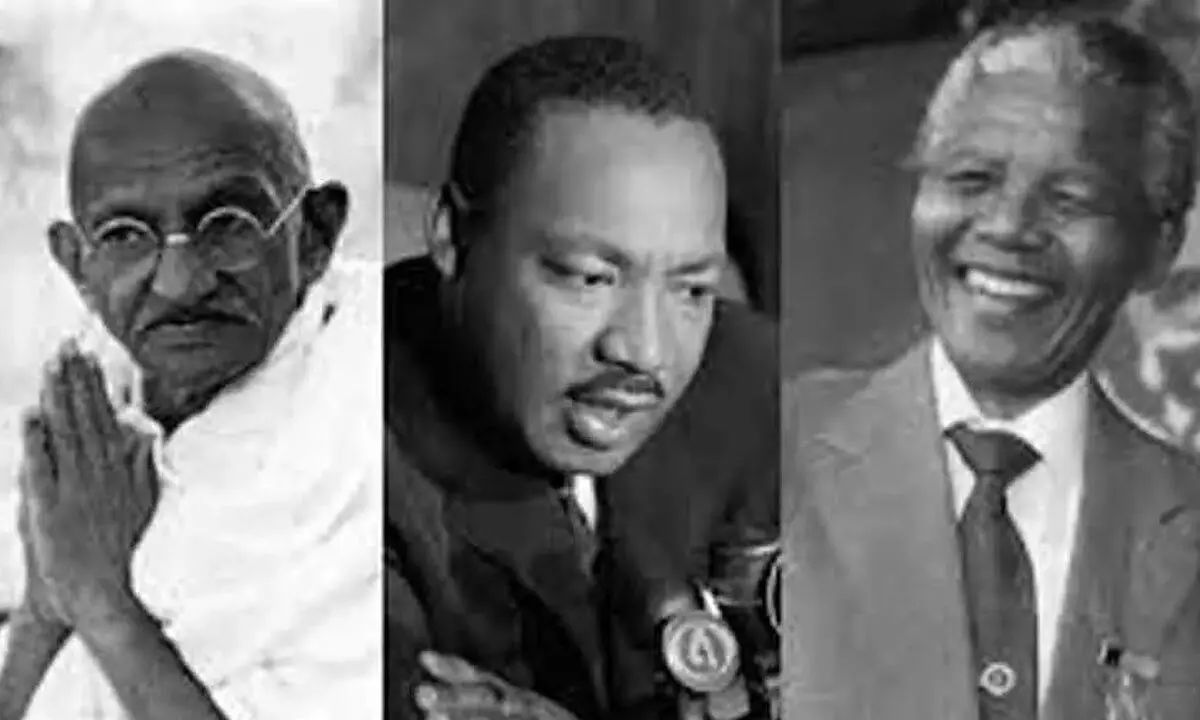
The photos taken from https://www.thehansindia.com/hans/opinion/news-analysis/relevancy-of-gandhi-king-mandela-ideals-802437
Prior to Gandhi, we had Buddha and Jesus. One of the popular songs of the cine-actor turned politician, MGR, film starts with the question ‘Why were Buddha, Jesus and Gandhi born? They were born to uplift the humans’ (4). This was written by Vaali, who had penned many songs for MGR. MGR in another film song, also written by Vaali, characterized Annadurai, the first CM of Tamil Nadu from the Dravidian movement as Gandhi of South (5). Annadurai was always against his party workers losing their life and career and he advised them to be mindful of their responsibilities. He brought in changes to the society through convincing people, winning elections and bringing in laws. One such law sanctifies marriages conducted without any rituals and not sanctifed by a religious head. Somewhat coincidentally, my marriage was conducted in this way and it is legal thanks to the law he brought in. Taleb in his book classifies people in to three different kinds: People with no skin in the game, skin in the game and skin in the game of others or soul in the game. His example for the three kinds are politicians, activists and revolutionaries (dissidents). Those with no skin in the game seek awards, prizes, honors, ceremonies and medals. Those who have soul in their game get the highest (even only) award which is death for one’s ideas and positions. He lists Socrates, Jesus, Saint Catherine, Hypatia and Joan of Arc. We have added Gandhi and King to the list. Thankfully, Mandela had a full life. Buddha managed it too. However, the powers that be who were affected by Buddha’s rebel could ensure that his fight against rituals was annuled eventually. Will the humanity ever learn and progress together?
References:
- https://earunan.org/2017/07/11/indian-institute-of-science-on-12th-of-july-mahatma-gandhi-and-morris-travers/
- Nassim Nicholas Taleb, “Skin in the game: Hidden asymmetries in daily life”, Penguin Books, printed in India by Thomson Press India Limited, New Delhi. Page 19.
- https://earunan.org/2015/02/01/rosa-parks-and-mooka-nadar-recent-tales-from-the-worlds-oldest-and-largest-democracies/
- https://www.youtube.com/watch?v=6TsCVgK5umM
- https://www.youtube.com/watch?v=RY3Q-PDv9qg
 earunan