Uncategorized

Even by crossing the oceans, chase wealth!

I suspect anyone who has seen the title and decided to read this blog could guess what I plan to write. Fulfilling an election promise, Trump decided to deport illegal immigrants from various countries in an army flight. Columbian President Gustavo Petro posted bravely lecturing Trump and within a few hours had to toe the line. He decided not to let US deport Citizens of Columbia in an Army flight as criminals and arranged Columbian flight to bring its citizens back with some diginity. An army flight from US deported 104 Indian citizens and the men among them were handcuffed and chained during the long flight that landed in Amritsar. Some are pointing out that the illegal immigrants have indeed committed a crime and deserved the treatment. Opposition parties are appalled at the inhuman treatment of Indian citizens. External affairs minister has pointed out that US has been deporting our citizens periodically and about 15000 have been deported since 2009, when the second UPA term started. I do not have any comments about the reactions of the ruling or opposition parties. I was thinking about my flight to USA in 1986, when I went to the Kansas State University to do my Ph. D and some of what I have read in Tamil.

During the mid 1980s, there used to be email groups in the USA, named soc.culture.xxx where members could exchange emails among themselves. This could be the earliest avatar of social media, like Facebook, Twitter or WhatsApp. I joined the soc.culture.india. I found one email with a title ‘x+1 syndrome’. It discussed about the life of a typical graduate student, like me, coming from India. I could relate to some parts of the article. When one reaches US, take some photographs in front of the University/Department and send it by airmail to the family to be received in typically 2 weeks time. The first car, first snow, and many other things are recorded in a film, devloped into a photo and sent by airmail. In a few years, the student would be informed by the parents that a suitable girl could be found for him to be married. Student goes home, gets married and returns to US with the bride. In due course, wife is expecting. The next sentence I read, hurt my pride: No right thinking parents in law would like to have their grand kid born in India, given the American alternative. I did not like this. I found out that I did not follow some of the typical characteristics given of a graduate student from India. My answer about ‘what would you do after studies?’ did not change throughout my stay there: Return to India. The article points out how it changes over a period of time. The main theme of that article was that no one returns from US and they keep saying they would return in the x+1 year with x changing always. I did get married and fortunately for me, my wife was also keen on returning home. I was prepared to accept a job wherever I would get. IITs, IISc, State Universities, Colleges, high schools wherever, as decision to return was final. It did not depend on what job I might get. We returned in 1994 and lived here since then. I have no regrets. I read news about some parents opting for pre-mature delivery, just in case Trump would bring in a law that would forbid their kids from being citizens of US. As I mentioned in a WhatsApp group, this is where the line dividing desire and greed blur. Greed could lead to disaster.

There is a proverb in Tamil which says ‘திரை கடலோடியும் திரவியம் தேடு’ (thirai kadalodiyum thiraviyam thedu) which roughly translates as the title of this blog. Literally ‘Run through the ocean and search for wealth’! Of course no one can run through the ocean and I am sure everyone gets the essence of this proverb. Wealth is important and only the super rich can say ‘money does not bring happiness’. Everyone else needs money to lead a dignified life. Most would like to find an honest way to earn what is needed. Those who are unable to earn what they consider as ‘enough’ where they are born, go wherever required to earn more. It could be to the nearby or far away cities in India or Abroad. This has been happening for several millennia. Columbus wanted to go to India through West and ended up in West Indies, which he was convinced was India until he died. There is a good satire by Trevor Noah, about Columbus’s confidence which comes naturally for the rich and affluent (1). Poor may be more doubtful about what they do.

Large number of Keralaites have gone to Arab nations in the recent decades leaving the family in Kerala with the hope of raising the standard of their families. Canada has a significant number of Sikhs. US had 5.1 million people of Indian origin, 1.47 % of its population in 2023 according to Wikepedia now (2). Gujarat and Panjab used to dominate the list of immigrants in the past and in recent decades people from Andhra, Telengana, West Bengal, Tamil Nadu, Maharashtra, Karnataka and Kerala are migrating in large numbers. Most readers may have heard about ‘ABCD’ meaning, American Born Confused Desi. One of my friend told me about ABCDEFGHIJ, American Born Confused Desi Emigrated from Gujarat Housed in Jersey. A Chemistry Professor from Rutgers University gave a seminar in our Department and showed the ballot paper from New Jersey which had the names of the candidates in Gujarati and English. Tamils have migrated to many places in the World over centuries: Sri Lanka, Singapore, Malaysia, South Africa, Canada, France and USA and settled there for good. Tamil is one of the four official languages in Singapore. The great Tamil Poet Bharathiyaar has a poem lamenting the conditions of Hindu workers, from Tamil Nadu, in sugarcane fields in Sri Lanka:

கரும்புத் தோட்டத்திலே – அவர் karumbuth thottaththilae – avar
கால்களும் கைகளும் சோர்ந்து விழும்படி kaalgalum kaigalum sornthu vizhumbadi
வருந்து கின்றனரே! ஹிந்து varunthu kinranarae! hindu
மாதர்தம் நெஞ்சு கொதித்துக் கொதித்துமெய் maathartham nenju kodhithuk kodhithumei
சுருங்குகின்றனரே – அவர் surunguhinranarae – avar
துன்பத்தை நீக்க வழியில்லையோ? ஒரு thunbaththai neekka vazhiyillaiyo? oru
மருந்திதற் கிலையோ? – செக்கு marunthithark killaiyo
மாடுகள் போலுழைத் தேங்குகின்றார், அந்தக்… maadugal poluzhaith thaenguhinraar, anthak …

In 14th Century, Pattinathaar lived in Kaveripoombattinam in what is Tamil Nadu today. He hailed from a rich mercantile family. He sent his son in a ship and asks him to bring weath. The son brought only sacks filled with paddy husks. Pattinathar got upset and angry and locked his son in a room. He went to the harbor and threw the sacks with paddy husks. He saw that they were all gold flakes/dusts and precious gems were hidden inside. He rushed back to the room where his son was locked. Son was not found and only a palm-leaf with a sentence written in Tamil ‘காதற்ற ஊசியும் வாராது தான் கடை வழிக்கே’ (Transliteration: kaathatra oosiyum vaaraathu thaan kadai vazhikae, Translation: Even an earless needle will not come with you in your final journey). In this story, the son is thought to have been divine and Pattinathaar realizes the futility of material life and renounces everything to become a Sanyasi (a Monk). While such stories tell us about some hard facts in life, we cannot forget that living in this world requires money / wealth. I remember another proverb in Tamil which says “பொருள் இல்லார்க்கு இவ்வுலகம் இல்லை, அருளில்லார்க்கு அவ்வுலகம் இல்லை” Porul illaarkku ivvulagam illai, arul illaarkku avvulagam illai, which means ‘this world is not for people without materials, that world (heaven, God’s abode?) is not for people without divine blessings’. (Added on 25 Feb 2025. Following a post by Kathir Krishnamurthy, I realized that this proverb has its origin in Thirukkural, verse 247 which is hardly a surprise: அருளில்லார்க்கு அவ்வுலகம் இல்லை பொருளில்லார்க்கு
இவ்வுலகம் இல்லாகி யாங்கு)

As a Scientist who has no understanding of God, I am not sure if that world exists. We do exist in this world and it is important to earn enough to lead a life with dignity. If one has not learned to earn and lead a life in ‘this world’, perhaps they can go to Himalayas and live alone in search of the other World. There is a popular song in Tamil from the movie Chandrodayam in which MGR and Nagesh act “காசிக்கு போகும் சன்யாசி உன் குடும்பம் என்னாகும் நீ யோசி”, ‘kaasikku pogum sanyaasi un kudumbam ennaagum nee yosi’ which translates into ‘oh monk on your way to Kaasi, did you think about what will happen to your family? My previous blog discussed my views about a Family. For most of us, it is important to find a way to earn and live within our means. I do hope everyone finds a way to lead a life with dignity. One needs to have some desire to earn and improve our lives and be supportive of our family. It is very important not to become greedy. It may be difficult to find out when our desire becomes greed. The recent movie ‘Lucky Bhaskar’ has a story which has the hero realizing this and leading a good life.

References:

  1. Trever Noah, “Where was I” Standup comedy show.
  2. https://en.wikipedia.org/wiki/Indian_Americans accessed on 8 February 2025

Standard
Uncategorized

Family = Love, affection, duty and right in reasonable measures!

May 15 happens to to be the international day for families. This year it was right in the middle of our Ph.D. interview week and I could not write this blog. I started it later and finally decided to complete this on 31st December 2024 as the world is anxious about the uncertainties all over. We have more than two wars. Election results in USA and several other countries and states in India have been of concern to some who consider themselves as liberals. Rebecca Trager has written a commentary in Chemistry World titled, ‘Trump is a disaster for Science’.1 I am reminded of a blog I wrote in 2017 after Trump won the first term and Modi demonetized Indian currency that led to disaster for numerous poor people in India.2 Clearly, New York Times would not accept 2016 to be the worst year ever. I suspect they would dub 2024 as the worst year.

In every nation and in every society, the importance of a family has been recognized. Liberal philosophers have always pointed out that all humanity is one family. I have mentioned an ancient poem in Tamil written by Kaniyan Poongundranaar which proclaims ‘yaadum oorae yaavarul kaeLir’ (“யாதும் ஊரே யாவரும் கேளிர்”), which means all towns are our town and all people are our relatives. When India became the head of G20 recently, the slogan ‘Vasudeva kudumbakam’ (written in Hindi in the image below) was chosen which means ‘the world is one family’.

While these are esoteric ideas, everyone knows what is practically meant by a family. I think family means, love, affection, duty and right (in Tamil காதல், பாசம், கடமை, உரிமை, kaathal, paasam, kadamai and urimai) among the members of the family and I must add in reasonable measures. Anything in excess cannot be good. The esoteric ideas pointed out above can be taken to mean that there is no need to hate anyone and we should all learn to live and let live. There is a proverb in Tamil which says “தனக்கு மிஞ்சி தான் தான தர்மம் (thanakku minji thaan thaana tharmam)”, which means you can help others and donate what you have after keeping what you need. I think this is applicable for time as well. Unfortunately, this does not tell you what one needs and that is upto the individual to decide. It is worth remembering what Gandhi said: “There is enough in this world for everyone’s need, not enough for a single man’s greed”.

A typical family, for me, starts with a husband and wife, who take a vow to share the good and bad life will bring. In typical marriages in India, this vow is implied and is not spoken loud.3 Whether the marriage is arranged by family or the individuals who are already in love with each other, this vow is important. Love and affection between them are necessary but not sufficient. There is an old proverb in Tamil which says ‘mogam muppathu naal, aasai arubathu naal (infatuation lasts for 30 days and desire lasts for 60 days). Life lasts much longer. It is important for the husband and wife to take responsibility in each others lives and also the liberty to expect help from each other as and when needed. It would be naive to assume that the husband and wife live happily ever after the marriage. Good and bad times will come. Facing them together, enjoying the good times and sailing through the bad times are essential. Love and affection could help in doing this for some time. If one does not recognize the importance of the duty and right that come with marriage, sailing together becomes difficult, especially when the going gets tough. Now, one can see how world as one family is not practical.

The major challenge for humans in a family, is balancing the interests of self and other members of the family. Between husband and wife, as equal partners, this is important from day one. Neither can expect the other person to take care of him/her all the time and it is important to give space and time for the other person. There will be situations in which one member has to do more and by nature there will be situations in which the roles reverse. With children, until they grow up, parents have to provide everything. Unlike the husband-wife relation which is expected to be that of equals, parents-children relation is typically, and rightfully, one sided. We need to take full responsibility for our children until they grow to be independent adults. Often unconditional love and support are given to children by parents. As the children grow and learn to take care of themselves, slowly some responsibility for the family falls on their shoulder. While most humans do feel sympathy when looking at everyone who is suffering, taking responsibility for everyone who suffers is impossible for anyone. Within a family, it is a responsibility and duty to do this. This is expected in a typical family and this cannot be applied to ‘vasudeva kudumbakam’. However, parents should not force or expect their children to be with them and help them always and let them do what they want in their life. In my view, parents are responsible for the children who are brought to this world by their act. This needs to be one-sided relation. Ultimately, the children have to move on and start their families.

I am convinced that every society recognized the importance of the duty and right that come with marriage. In India, Hinduism (broadly encompassing all religions originated and grew in India, perhaps except Sikhism, Jainism and Buddhism) emphasized this. The most popular poet from Tamil cinema, Kannadasan, wrote several volumes titled ‘arthamulla indu matham (அர்த்தமுள்ள இந்து மதம்)’ translated as ‘The meaningful Hindu religion’. and there is a popular song of him that begins with these words. It starts by saying ‘the meaningful Hindu religion assigned duties for every human’. This includes duties to the family and also to the society, as every human has several roles to play. Thirukkural in Tamil has a chapter each, outlining the roles of different individuals as well. When one recognizes and accepts the importance of duty and right, this continues for life, and members of the family have to do it without any expectation.

Bhagavad Gita emphasized doing one’s duty without expecting anything in return. This is a deep thought that most would accept individually. However, in practice this can be used for exploitation. Ideally, every one should have the liberty to choose what is his/her duty. However, once chosen, (s)he has to remain dutyful. There will be times when some in the family feel others are not doing their part. This could be real or perceived. It would be human nature to exaggerate one’s own contributions. It would be good to have an open discussion and sort these issues out through discussion. It is important for both parties to talk AND listen. Family is an important unit for humans and every attempt to preserve it is essential in my view. As long as family survives, the humanity can survive. Any attempts to dislodge the family structure would be viewed with skepticism by people at large. Perhaps that explains some of the election results. I wish everyone a happy, healthy, peaceful and prosperous new year!

References:

  1. Rebecca Trager, Trump is a disaster for Science, Chemistry World, page 6, December 2024 issue.
  2. 2017 will be a great year for India and the World! | earunan
  3. I found this vow on the web: “I take you to be my wife/husband, to have and to hold from this day forward; for better, for worse, for richer, for poorer, in sickness and in health, to love and to cherish, till death us do part”. There is a beautiful Tamil film song from Vinnaithaandi Varuvaaya which has this vow. https://www.youtube.com/watch?v=bXa-wbiXiOw In case you know this song, the first line is worth remembering and it is equally important to realize that the second line implies blind love, that cannot last forever. If it does, it is comparable to fatal attraction.

Standard
Family

My parents: என் பெற்றோர் (En petRor)

My father was born in 1937 in Tallakulam, Madurai to Gurunathapandara Mudaliar and Kamalayee ammal. He was named Aaladi. We had a ‘jeevasamaadhi’ (a grave in which someone alive is buried based on that person’s wish) which was called Aaladi Saami Madam (Saami in Tamil could mean God or Godmen) right next to where he and I were born. Aaladi was a cousin of my great grand-father Nallathambi Mudaliar. My father was born in the family of ‘kaariyakkaarar’, perhaps like a ‘Secretary’ for the group of people in that neighbourhood. This responsibility came by birth. Nallathambi Mudaliar did a lot for the society and when he passed away, the locals insisted that he be buried in their neighbourhood, Parasurampatti in Madurai. We visit his Samadhi twice a year, during Pongal and Chitra festival as a family and pray. He fought in a local election, perhaps to serve the people more but lost the election. Moreover, he lost almost all our wealth in this process as well. My grandfather, Gurunathapandara mudaliar, was a man of principle. He ensured that all loans were settled with interest and my father could start from zero rather than being negative. My father was in pre-University when my grand-father passed away and the responsibility for the family fell on his shoulders at that young age. He joined the small business (cloth merchants) we had. He was an excellent football player and has represented school and played in the city tournaments. His education and football came to a grinding halt after he lost his father. All his life he worked to ensure that the family survived and grew. As we grew, he did a lot to ensure that all our relatives, neighbours, community, and anyone and everyone he got to know could grow. He encouraged everyone to get a good education and work hard.

My mother Chellammal alias Seetha was born to Kulandaivelu Mudaliar (chinna thatha) and Paappammaal in 1941. Kulandaivelu Mudaliar’s elder brother was Sellachaami Mudaliar (periya thatha), who was a born-leader. My mother was one of the five girls born to their parents along with five boys. There could have been a few more babies that did not survive. On the contrary, Sellachaamy Mudaliar and his wife Parattai had only one daughter. Both brothers lived as joint family and all eleven kids lived like having two fathers and two mothers. Periya thatha was the care-taker for the family who made the final decision for the family. They lived in a big bungalow, with two floors and an open-terrace and prayer room in the third floor. This was in the Old Agraharam in Chinna Chokkikulam, just about a km from our ancestral ‘home’. My father was living in a mud-house with tin-sheets on top and there was perhaps only one room with a kerosene stove in the corner. There was no attached bathroom/toilet. We had a well in that area and several other huts. Periya thatha decided that my mother would be married to my father, though the difference in their financial status was huge. My father’s family had a reputation which periya thatha was well aware off. He not only got them married, but also got my father initiated in a new business, as a petroleum dealer.

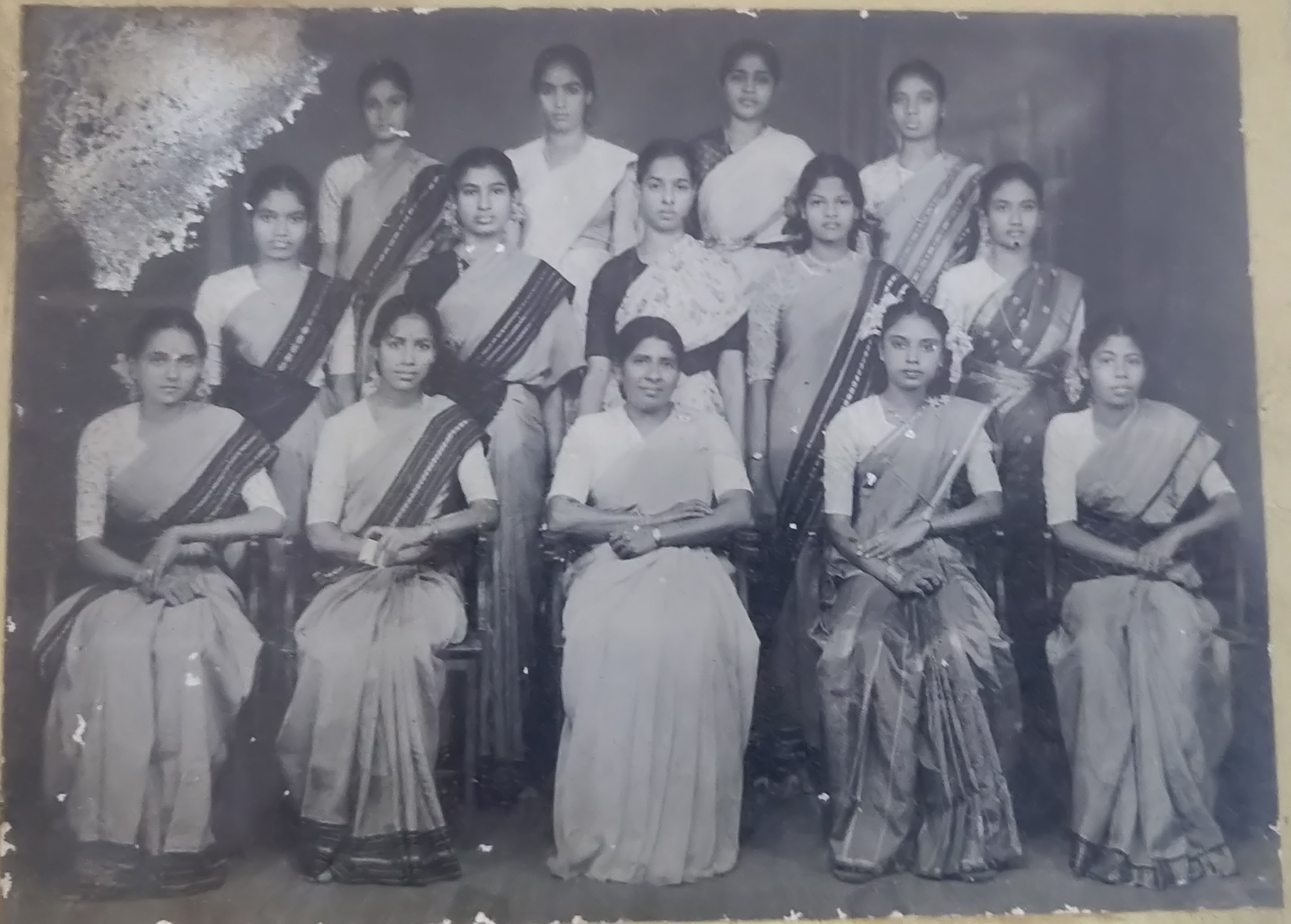
Before marriage, my father excelled in football and took active interest in the Dravidian politics. He voted positively in the Trichi conference of the newly found DMK in their referundum to decide whether to become a political party or remain as social organization like it’s predecssor DK. When he joined pre-university, he decided to give himself a new name. He liked Balakrishnan but did not want to give a ‘sanskrirtized’ name. He called himself Elangannan (இளங்கண்ணன்) which means the same in Tamil. In Tamilnadu, by then people stopped adding caste name as their last name. Kids were given a name and an initial that came from their father’s name. Hence, my father became G. Elangannan and I became E. Arunan. This is continuing to cause problems for people born in this state as they need to give a first/given name and last/family name everywhere else in India/abroad. My father is third from the left in the top row.

My mother before marriage grew up in the big bungalow. Sellachaamy Mudaliar was very close to Swami Sithbavaananda who ran the Ramakrishna Matt in Thirupparaithurai, near Trichi, called Tapovanam. Swami always stayed in their bungalow when visiting Madurai. Tapovanam ran a boarding school in which all five of my uncles studied until their pre-University. My mother studied in a school in Madurai and excelled in her studies. She got a state-rank in her school final year. My mother is second in the middle row from left.

My mother’s studies ended on getting married to my father in 1959. In addition to the huge differences in their background, my father was a non-vegetarian and my mother was a vegetarian. My mother learned to cook non-vegetarian food as well. Though my father’s family was as religious as every other family those days, my father grew up following the self-respect/Dravidian movements. We have heard that he refused to give a horoscope for checking before their marriage. He named their first son as Thambidhurai and me as Arunan. The third child, a girl was named Vanathi and all these were typical names given by the people involved in the political movement. Their fourth child was a girl as well and my mother preferred to name her Meenakshi, the Goddess whose name invariably follows Madurai, and my father wanted her to be named Bharathi. With a compromise, my second sister became Meenakshi Bharathi, and everyone called her Meenakshi (this is one of the reasons I chose Bharathi as the name of my first daughter). Sellachamy Mudaliar and Chellammal’s influence on my father transformed him dramatically and he became a staunch devotee and a committed family man conscious of his societal responsibilities. The two boys born after Meenakshi were named Sidharthan and Ramalingam.

On Mondays he would not leave home between 7:30 AM and 9:00 AM, as this is considered Ragu kala, an inauspicious time to start anything. His daily routine was leaving home before 8 AM and reaching home around 9 PM. He liked to have a chikki (a sweet toffy made of groundnut and jaggery called kadalai mittai in Tamil) and some betel leaves in the night. I used to go to a petty shop after he comes home to buy these. Those days, buying them in packets and storing them for days or weeks was not common. This was done everyday! As children, we rarely got time to spend with him but could always feel his presence. There was a stick visible at home which was used to warn us by mother at home: Appa will beat you with that stick! I grew up in a time when children aged 5 or more joined 1st Standard in a School. I did my first year of School at Nehru Vidhyalaya in Madurai. My elder brother was already in that school. We were both moved to a school formed by our community in Tallakulam in which my grandfather and father were actively involved. My father learned about T.V.S. Elementary School and felt we should be moved there. He met the school principal repeatedly pleading for admission to his family kids. One year the Principal agreed to admit one student brought by him. He decided to put his elder sister’s son instead of my elder brother in TVS School. His elder sister, my aunt was no more and he felt that her son should be given priority. He continued to visit TVS School pleading to admit his sons/nephews and eventually I was admitted in the 5th Standard. Indeed, that took me to where I am today. That was my third and final school and I had not gone to a kinder garden or pre-school. During the summer holidays after 5th, I was enjoying the vacation and had forgotten that I had to go to school for securing admission to 6th, which was in their High School. I still remember my father coming home during the day reminding me and taking me to the school in his scooter.

My mother was always home and she taught us everything. My handwriting has never been good. I had difficulty in writing 2 after 1 and I remember my mother sitting with me with a slate and chalk and helping me write 2. Discipline was taught from the beginning. I remember winning some lottery, 50 paise during my elementary school days when one Dosai was 20 paise. I told my elder brother and we both went to a hotel near our home to have Dosai. Our mother found this out and when we returned home in the evening, we were beaten heavily for venturing out to a hotel on our own. She told us stories like Ramayanam and Mahabharatham. We learned Thevaram and Thiruvasagam and recited them in the morning and evening. Particularly, in our grand father’s house there was a prayer every morning and evening when all of us would sit and recite these devotional songs for about half an hour. The prayer hall had a photo of all our major Gods, including one of Jesus and Mecca.

My father used to tell us several things as a common wise man from his experience. A few of them I remembered and followed. I do owe whatever I could achieve to these three things (they sound and rhyme better in Tamil and I have given it in Tamil for those who can read): 1. Even if your ship sinks, do not worry (கப்பலே கவுந்தாலும் கன்னத்திலே கை வைக்கக் கூடாது kappalae kavunthaalum kannathilae kaivaikka koodaathu); 2. Let us tie our hair and pull a hill, if it comes it’s a hill and if not we only lose a hair (மயிரைக் கட்டி மலையை  இழுப்போம் வந்தா மலை போனா மயிர், mayiraik katti malayai iluppom, vanthaa malai ponaa mayiru). 3. If we go to a town where everyone is eating crab, ask for the middle piece (நண்டு திங்கிறவங்க ஊருக்குப் போனா, நடுத்துண்டு எனக்கு வேணும்னு கேளு, nandu thingiravan oorukkup ponaa, naduthundu enakku venumnu kaelu). The first one convinced me that I would never worry about anything and focus on what I can do at any given situation. The second one convinced me of the importance of trying our best without worrying about the prospects. And the third one taught me to adapt to the local environment. It helped me live with peace and joy wherever I lived. It is well known as ‘while in Rome do what Romans do’.

My mother’s influence is difficult to write in a few sentences like this. She was always there for us and worked tirelessly. I realized that among our age-group boys, we were perhaps the only ones not to utter any common curse words one hears in every language, everywhere. In general, all of us were well behaved students in the school. Anything we needed, Amma was the first person to be approached.  My father and his younger brother (Nalla Thambi Chithappa) lived as a joint family as well. He and his wife Rajeswari had four children. I remember vividly one day, my chitthappa was carrying the body of a baby within a few days after birth. In 1970, my father, with the support of periya thatha, built 8 houses in a row with tiles on top. Each house had an entrance, a hall and a kitchen. All the eight houses at the end had a continuous 3 feet service area and we had three toilets for the 8 families at the end. Appa and chithappa stayed in the middle two houses which were joined and the other 6 houses were rented. Men and children would take bath right behind the houses, where there was a water tap. Women in the house would all take bath after sending the men to work and children to school. A compound wall separating our houses from the TVS Sangeetha Samajam was there on the other side and there was no roof to this service area. We lived in this house until 1981, when my parents moved to an independent house having toilets at the backside.

I went to USA in 1986 for my PhD and my wife, Thenmozhi alias Gomathi joined me in 1990 when we got married. We had our first daughter born in February 1994 in Urbana. My mother came to USA before delivery and was with us for close to 9 months. My father joined after I got the job at IIT Kanpur. I called him to inform about the job offer and asked him to visit us. I told him that we are returning for good and that would be an ideal time for him to visit USA. Somewhat coincidentally, USA was hosting World Cup Soccer that year. His first response: If you can take me to world cup soccer, I will come. Until then, I was not thinking about going to a game, though in Madurai I used to get season ticket to watch the football tournament every year. I did not know if tickets were available at that time. I told him that, I would try but he should visit us whether or not I succeed. I disconnected the call and called the number available for booking world cup tickets. “Hello, this is World Cup Soccer ticket booking online, can I help you?” “Yes I would like to buy tickets for the Spain-Bolivia game in Chicago” “I can help you with that, how many tickets do you need?” I was not expecting to hear this. I knew Appa and I would go. Would anyone else among my friends be interested? I answered 4! “Here is your confirmation number. Come to the stadium two hours before the game and collect your tickets”. I could not believe it. I called my father immediately and told him: I got the tickets, plan your travel. Then I called some of my friends and asked them: World cup tickets for the game in Chicago are available, are you interested? In a few minutes we needed 10 more tickets. I called the helpline again and I was told: Sold out! My parents during a visit to Niagara Falls in 1994.

My parents complemented each other very well and our house was always full. All our cousins, their friends, and our friends were all at our home almost on a daily basis. My mother cooked delicious food, snacks, made coffee any time and all the time. My father would encourage all of them to do well and enhance our skills. Both of them would host everyone with smiling faces. My father was very active in business associations, our temple priests association, Socio Economic Society (SES, which was formed to help people from our community) and any and all groups he was part of. Our ‘kula theivam’ family god is Sithar in Puliyuran village near Aruppukottai. All those having Sithar as kula theivam come from one clan and they are called ‘pangaali’s, translated as share holders in English. As it may have been typical, in some generation, two brothers must have had an irreconcilable difference and their families and generations since became arch-rivals. Since then we have our pangaalis and ethir-pangaalis (opposite group). The most important festival we celebrated was Sivarathiri. The two groups came to an agreement that they will celebrate the festival and take care of the temple in alternate years. Two groups do nothing together, except on the Tamil New Year day, they would assemble in the Temple and exchange keys. My father did a lot to unite the two factions and now I see more interactions between the two groups. My mother remained the backbone supporting him in everything.

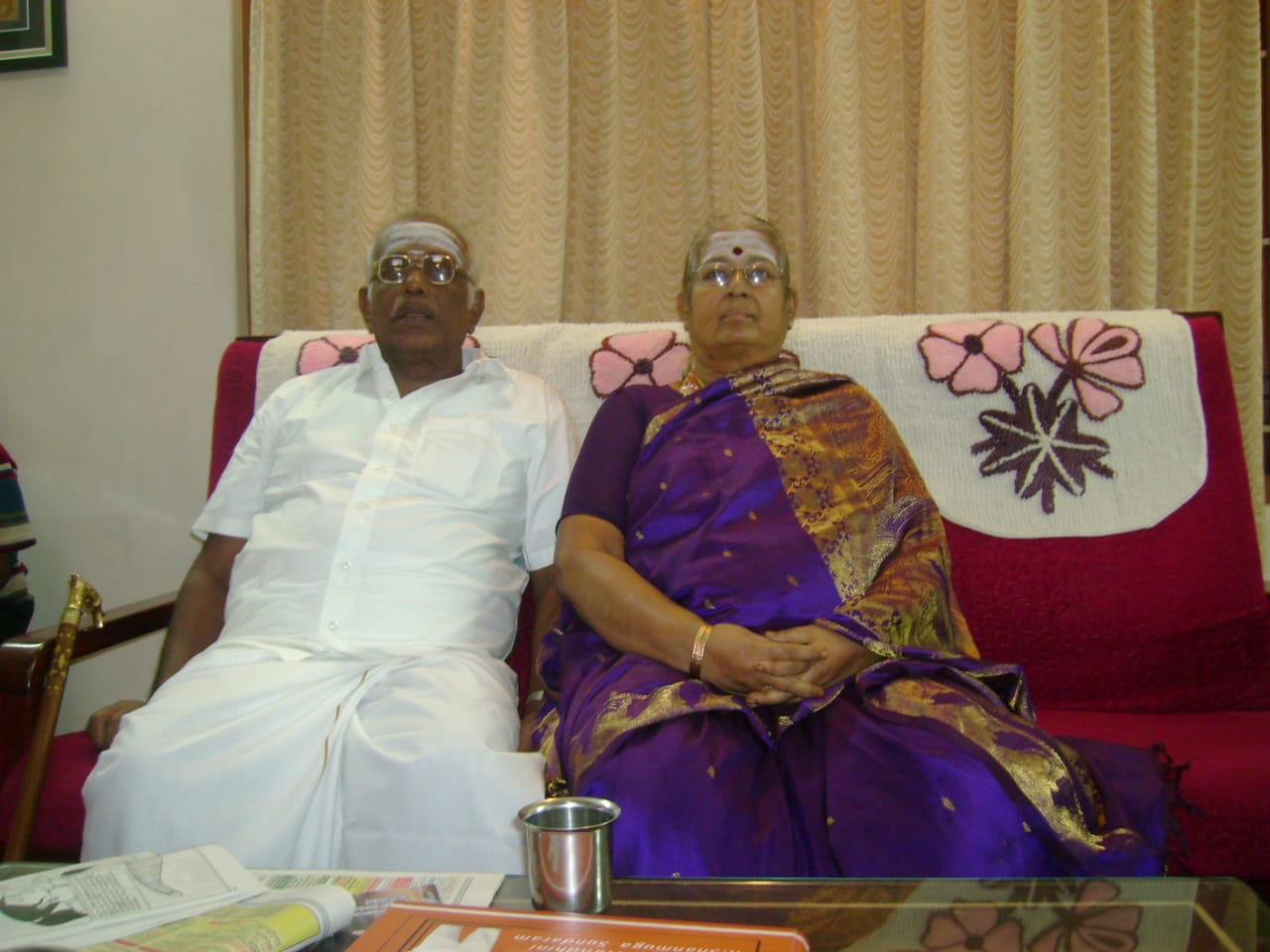
My mother passed away on 18th April 2014, during the Chitra Festival after 55 years of married life. My father passed away on 17th January 2024, during the Pongal Festival. These were the two festivals during which we visit our great grand-father’s samadhi in Parasurampatti. I would have yet another important reason to visit Madurai during these festivals. Today’s generation may not be able to appreciate what they did in their life, starting from agreeing to get married to an ‘incompatible stranger’! They accepted each other whole-heartedly and lived a great life. They have together, raised not only our family, they have raised a village. None of us could have done what we did eventually in our life without their hard-work, unflinching support, love and care. In Tamil, there is a saying ‘annaiyum pithavum munnari theivam’ which translates to ‘mother and father are the primary gods’. In Sanskrit, the saying goes ‘Matha, pitha, guru, theivam’. We have been fortunate to have our primary gods as ideal parents.

Standard
Uncategorized

Balance for the better: Empowering Women and Family!

This is a blog I started writing last year but did not complete. The recent birth anniversary of Periyar (17th September) and passing away of the second women to become a Supreme Court Judge in the USA, Ruth Bader Ginsburg (18th September) motivated me enough to complete it today. Ruth was shocked to learn that she was demoted after becoming pregnant with her first child in 1955. [1] She rose in her career and ensured to give judgements that protected working women and men.

I attended the Gordon Research Conference in Orange County, California in 2016 and Royal Australian Chemical Institute’s Physical Chemistry Conference in Perth, Australia in 2019. Both these events had a special session to discuss about empowering women in Science. The International Advisory Committee members of the International Symposium in Shock Waves got emails from a group pointing out that there was no women in the list of plenary speakers in 2019! Compare this to what was happening during the 1930s in Tamil Nadu. E V Ramasamy organized self-respect conferences [2] all over Tamil Nadu and in most of these conferences women were the lead speakers! During one of this meeting, he was given the title Periyar, a noble human. His views on feminism might appear too liberal even to the left-wing liberals of today. [3] Often it becomes important to pull the pendulum to the other extreme to bring balance.

On 6th April 2019, we had a panel discussion on “Balance for the better: Empowering Women” at the Inorganic and Physical Chemistry Department, Indian Institute of Science. I had become the Chair during October 2018. We have an Al(l)Chemist’s Society in the Department, which is managed by the third year Ph. D. students. They take care of the ‘extra-curricular activities’ for the Department and arrange several of them throughout the year. On 19th January 2019, we had a panel discussion on ‘Social Responsibilities of Science/Scientists’. I should write about it some time too. I have been planning to write about this meeting for some time and could not do it yet. The decision in May 2019 of the Senate in Alabama to ban all abortions and the attack on Vidyasagar’s statue in Kolkata around that time pushed me to start the blog in May 2019, but did not complete it.

Secretary of Al(l)Chemist’s Society, Ms. Rinkumoni, wanted to have one lecture arranged on 8th March, which happens to be the International Women’s day.

The President of Al(l)Chemist’s Club is Dr. K. Geetharani, first woman faculty in our Chemical Sciences Division since the early 1990s. Their first choice for the speaker was Prof. Rohini Godbole, an honorary Professor in the Center for High Energy Physics at IISc now and she also received Padmashri award in 2019. She has been an outstanding physicist and has also championed the cause of Women in India and all over the world. We could not do it on 8th March as Prof. Godbole had other commitments. I was suggesting to the Al(l)Chemist’s society that we could have a panel discussion on this important topic. April 6th was chosen, as that was when Prof. Godbole and the other panelists were all available. (This happens to be the birthday for my wife and an aunt who was staying with us when we were both working full time. I was delighted with this coincidence but did not tell about this in the meeting ). We had three other professionals in the panel discussion. They were: Prof. Dipshikha Chakravortty, Professor at the Department of Microbiology and Cell Biology and also Chair of the Internal Committee Against Sexual Harassment (ICASH) at IISc; Dr. Nirmala Rajendran, one of the Medical Officers in our Health Center, also a member of ICASH; and an alumnus of our Department currently working in an Industry, who does not want to be named.

Prof. Godbole started the day with a talk on Women in STEM. She started by informing the audience that she had given talks on this topic all over the world, except in IISc, in a meeting she did not organize. It was indeed a surprise and I was glad that our Department did it. She brought out an important point. It is not just that women need to do Science. Equally Science needs women. So, she felt the title ‘Empowering women’ itself is misleading. I was somewhat relieved that Al(l)Chemist’s added ‘Balance for the better’ to the title I had suggested. All over the world, it is being recognized that diversity in work place does improve the performance of an organization.

Dr. Nirmala Rajendran spoke about health issues of working women. One important suggestion she gave was that women should not hesitate in asking others to contribute in sharing the workload at home. Often working women put so much burden on themselves and feel guilty of doing less both at work and home and it is important to avoid this guilt trap. Dr. Nirmala gave important tips for women about how to stay healthy in a professional career. Our Department does have a significant number of women among our Ph.D. research scholars and her talk would have been useful.

Prof. Dipshikha Chkaravortty spoke about the Institute Committee Against Sexual Harassment (ICASH) and informed the students about what one could do when facing sexual harassment in the lab. A teacher-student relationship is unequal and it is important that the teacher does not exploit this. Having power and not misusing it should really be the norm. However, misuse happens often and suffering in silence becomes the norm. Every system is trying to bring in rules and regulations to stop sexual harassment. Our Institute has established ICASH and Prof. Chakravortty discussed about the committee’s efforts to stop sexual harassment in the campus. I was shocked to read a statement from Ruth Bader Ginsburg in her Wikipedia page [2]: She also reflected on her own experiences with gender discrimination and sexual harassment, including a time when a chemistry professor at Cornell unsuccessfully attempted to trade her exam answers for sex. She had mentioned this during the Metoo movement expressing her support recently.

The fourth speaker was an alumnus from our Department working in an industry after some time in academia. I wish she could have continued in academia and realized she had to quit for personal reasons. It rarely happens to men. During her talk, I realized how important it is to have representation from all sections before making a decision. In the Department she served, there was a discussion about when to have a faculty meeting to discuss budget. Based on overwhelming choice, not a simple majority, it was decided to have this meeting in late evenings, 7 – 8 PM. I can relate to this decision in a new Institute trying to establish it’s name. However, she could rarely attend this meeting having a young kid to take care off. She did point out about a male colleague who had this same problem as his wife was working in another town and he had to take care of their kid after office hours. This is precisely why we need participatory democracy and rule of law ensuring that minority rights are protected. While a majority is enough to form a Government, decisions affecting a group cannot be made without hearing their opinion.

After the four lectures, we had a panel discussion involving all the participants, moderated by Rinkumoni. Four speakers served as panel members. The discussion was lively. It was pre-covid days and we did not record the proceedings. I wish we had. As I had mentioned above, when forcing a required change, one sees that the pendulum goes to the other extreme. I added family to the title today. Peiryar pointed out that family is oppressive to women. I have seen this to be true all over the world. I also feel family is a very important small unit for humans. While ensuring that women are not suppressed and harassed is extremely important, throwing the family structure would be similar to throwing the baby with hot water.

Ultimately, it is important for humans to find the right balance and act towards personal and common good. Both Periyar and Ambedkar, who lived their lives fighting for social causes, married much younger women when they were really old. These marriages were both based on mutual consent and for me they do not invalidate their work. As I get closer to 60, I feel it is important to have someone to share your life with. An Abdul Kalam or an Anna Mani could remain single and have a long and successful professional career and life. For most ordinary human beings, like me, it is good to have someone to call as a family. It is possible to have one where every member can pursue their interest and find a way to balance their individual and collective growth. That is indeed balance for the better.

References:

  1. Ruth Bader Ginsburg: https://en.wikipedia.org/wiki/Ruth_Bader_Ginsburg Accessed on 20 September 2020.
  2. S. Anandi, Women’s question in the Dravidian movement 1925-1948, Social Scientist Vol. 19, No. 5/6 (May – Jun., 1991), pp. 24-41 https://www.jstor.org/stable/3517871
  3. Periyar feminism, Ed. K. Veeramani, 2010. Periyar Maniammai University publication.

Standard
Uncategorized

How about both? or Having (half) the cake and eating it too!

I remember hearing a story from Thenali Raman’s life. He was the wise man in the Court of Krishnna Deveraya. During his youth, he prays to Shakthi for long, Shakthi appears in front of him! She has two glasses in her two hands. She tells Thenali: “If you want more knowledge, take this one and if you want more money, take the other one”. Before Shakthi could wink, Thenali Raman grabs both and drinks them. Why do you have to choose? I have consciously tried not to choose between two things I love and have managed to have them both, may be less of each!

I went back to USA with my wife, within two weeks after our arranged marriage. When we got married, I had four years of cooking experience. Living in an apartment as a Ph. D. student, and not liking bread and cereal for breakfast, I used to cook most of the meals. My wife had three years working experience, as she started her work after her BTech and was staying home. When we were in USA, we did share the house hold duties. I soon realized that she had learned cooking better than I did as well. I used to help in cooking in general. Cutting vegetables and washing dishes were my part most of the time. I ensured that the kitchen sink is clean when we went to bed every single day! Cockroaches used to be a serious problem. One day, she asked me: We are having Dosas for dinner, shall I make coconut or tomato chutney? I had the standard reply: Why not both? Some of my friends could not believe I would say this to a recently married wife 🙂

After coming to USA, my wife started doing MS in Computer Science. I was in the last year of Ph.D. When I completed, she still had close to a year. From August 1991-April 1992, I stayed back as a postdoc in the same group. My advisor was going on a sabbatical and he was also asking me to stay back and take care of the group, projects, etc… It turned out to be ideal, though it is generally not a good idea to continue as a postdoc in the same group. I got a postdoctoral offer from University of Illinois and we both moved to Urbana-Champaign. My wife could have applied for a job in Silicon Valley. She came with me to Urbana and worked for Wolfram Research Inc.

We were both certain about returning to India. We had our first daughter born in February 1994 and I had an offer from IIT Kanpur in June 1994. My wife resigned her job and we returned to Kanpur in November 1994. We decided to have another kid and thought it may be better to have one long break rather than two short breaks. We were blessed with our second daughter in 1996. Though we were both from big families, we could not have any one staying with us and help those days. I used to teach 13 hours a week and stay home most of the other time. I delayed submitting my first project to DST till 1996. One of the member in the committe asked me: Why did not you submit it last year? I told him, I had some personal reasons. I moved to IISc in May 1997 and the project was sanctioned only by the end of 1998 and funds released almost a year later. It is difficult to believe! I started my job in November 1994 and I got DST funds to build the microwave spectrometer in November 1999. Of course, I had students and they need to have their degree.

I started a very successful collaboration with Aerospace Engineering Department at IISc and my first student did his Ph. D. work in Aerospace Engineering in a field that was new to me and of course to him. Now this brings me to the major choice for young academics. To do independent work or to collaborate? The answer is: Why not both? One needs to develop an identity for oneself and also explore avenues for collaboration which can lead to synergistic output. It is possible. We built a pulsed nozzle Fourier transform microwave spectrometer at IPC and single pulse shock tube facilities at the Aerospace Engineering. Both involved time and unbelievable efforts. My promotion to Associate Professor position happened nearly 9 years after becoming an Assistant Professor. IISc usually has a six year period for evaluation, unlike IITs, which could give promotion to faculty members in 3-4 years. Of course, my 5 semesters at IIT Kanpur were not considered. I had no issue, as I needed that time to establish unique laboratories.

Having worked in IIT Kanpur for 5 semesters and taught several courses, I started teaching regularly in IISc. Another question for young academics: Teaching or Research! My answer is the same. Why not both? As Zare wrote in an Editorial in Current Science, anyone with a Ph. D., can become a good teacher with some effort (1). I had reviewed books for Current Science (2,3), I had served as Snack Parlor Secretary in our Faculty Club and I was the Amenities Committee Chairman. One can do teaching, research, and some administrative work as a young faculty member. All of these, without ignoring the family. I remember one incident very well. My wife had to go to Chennai with both our daughters. I could not take a break and go with them. I did not want to send them alone either. We went in Lal Bagh express which left Bangalore in the afternoon and reached Chennai in the night. My father in law came to take them home. I went to the other platform and took the night train back to Bangalore the next morning.

Another major question that young academics face is, basic or applied research. Should we do experiment or theory? The answer is the same. It is better to work on problems that interest you. We have done both basic and applied research in our group. We have done both experiments and computation. The current definition of hydrogen bond approved by the IUPAC is based on our initiative (4). We could put the most important noun and verb in Chemistry, carbon and bond, together like no one would have imagined (5). We could also show that a simple chromium coating could reduce drag for a rocket/missile (6). This work received unexpected coverage in both science magazines and newspapers, in India, Pakistan and the USA.

We have been told from the beginning: You can’t have the cake and eat it too! You have to give up something to get something. What we need to realize is that we can have some cake and eat it too. We should learn to make the choices with which we can live happily. If I had submitted the project to DST as soon as I returned, I may have been promoted earlier. If my wife had gone to silicon valley after her MS, her career could have progressed differently. After taking a 5 year break, she started her career and did very well in career as well. It would not come as a surprise to anyone that anytime she worked, her salary package was always significantly better than mine.

At every point in our life, we could have chosen to put family or career ahead of the other one. We consciously decided to find a balance. Never make one more important than other. Whether it is career or family, teaching or research, basic or applied research, coconut or tomato chutney, you can find a way to have them both! As everyone is different, the choices we made may not be the most appropriate for others. However, everyone can find a balance with which they can live happily. We win some and miss some, staying together is a blessing. May everyone who has read this for, and also others who may not read this, find the right balance in having the best, a career and a family can offer.

References:

  1. https://www.currentscience.ac.in/Volumes/102/01/0009.pdf.
  2. https://www.currentscience.ac.in/Downloads/article_id_078_02_0202_0203_0.pdf
  3. https://www.currentscience.ac.in/Downloads/article_id_079_09_1392_1393_0.pdf
  4. E. Arunan, G. R. Desiraju, R. A. Klein, J. Sadlej, S. Scheiner, I. Alkorta, D. C. Clary, R. H. Crabtree, J. J. Dannenberg, P. Hobza, H. G. Kjaergaard, A. C. Legon, B. Mennucci and D. J. Nesbitt. Pure Appl. Chem. 83, 1619 (2011).
  5. Devendra Mani and E. Arunan Phys. Chem. Chem. Phys. 15, 14377-14383 (2013).
  6. V. Kulkarni, G. M. Hegde, G. Jagadeesh, E. Arunan and K. P. J. Reddy. Phys. Fluid, 20, 081703 (2008).
Standard
Uncategorized

Prakash Krishnaswami: An incredible human being and a close friend!

Prakash during a visit to Urbana, Illinois in 1995

It is 10 years since Prof. Prakash Krishnaswami, a distinguished faculty member at the Mechanical and Nuclear Engineering Department at Kansas State University (KSU) departed us. Thinking about him and the last time we met him and his family, I am reminded of one of the quotes of Einstein, that I like very much: There are only two ways to live life: One is as though everything is a miracle and another is as though nothing is a miracle. Summer of 2007 was somewhat of a miracle in our life. I do not know the context of this quote. It also taught me that Einstein’s quote misses an important aspect of life. Life has misfortunes in addition to miracles. How did this summer of 2007 teach me about miracles and misfortunes? I need to rewind by 2 more decades.

In 1986, I moved to Manhattan, Kansas to start my Ph. D. in Chemistry. Manhattan is a small University town. When I left India, my mind was blank. I had no idea how my life would unwind in a foreign land. At that time, there were about 18000 students out of which, perhaps about 100 were from Indian sub-continent. There were a few faculty members from India living with family. It turned out I had a great time at Kansas State, thanks to an excellent group of people both in the University and in the little town. One prominent member of that group was Prakash. He had just married Sujatha and they both returned to Manhattan shortly before my arrival. We became very close friends. Most students going to Kansas State University those days would have enjoyed the hospitality of Prakash and Sujatha. Between 1986-92, when I was there, there was always some friend(s) with/without family staying at their home for days, months or years. They disproved the popular proverb in Tamil which says “medicine and guests are good only for 3 days” emphatically. In Tamil, it naturally sounds better ‘Vriundhum marundhum moonru naal (விருந்தும் மருந்தும் மூன்று நாள்)

I do not remember when we met first. Prakash was unusual, unassuming, empathetic and an abundantly talented individual. I learned that he had completed his B.Tech from IIT, Madras with flying colors. Somewhere down the line, he had also learned to fly. I thought of asking him to take me along during one of his flying session but never did that. After joining KSU as a faculty member, he registered for an MS in Mathematics and completed it. During 1986-90, we lived in Manhattan as close family. In 1990, I got married to Gomathi in Chennai and Prakash and Sujatha attended our wedding. Fortunately, they were visiting Chennai during that time. Our marriage was arranged by the families. Naturally, Gomathi had concerns about leaving home and traveling with a stranger to a foreign land. I remember telling her this: “We have great people all over the world”. Prakash and Sujatha were in my mind, along with many other friends from Manhattan.

During our stay in Manhattan, we used to drive away, often late in the night with friends to exotic locations. Prakash, Sujatha, me and Gomathi on one such trip with many other friends.

During 1990-91, I became the President of the India Students Association (it was not Indian and I never figured out why). Prakash was the Faculty Advisor. That year ISA expanded its activities nearly astronomically. In 1992, we went to the University of Illinois at Urbana-Champaign. We missed no opportunity to visit each other or travel together. It was also helped by a sabbatical Prakash took in Argonne National Laboratory in Chicago during that time. That was another eventful time. We had taken a friend from Urbana to Chicago and stayed with Prakash and Sujatha. That friend was Prof. Ramananthan, an eminent Mathematician from TIFR who was visiting UIUC. His life was a mix of miracles and misfortunes as well. I should write about that some time. By September 1994, Gomathi and I returned to India with our first daughter. Of course, before that we visited Manhattan staying at Prakash’s home for a few days. They had their only son Azad with them at that time.

After returning to India, we continued to be in touch and were lucky to have many opportunities to spend time together. Prakash did spend a semester each at IISc and at IIT Madras. After this, he was hopeful of returning to India for good. Unfortunately for India, that did not happen.

In May 2007, Prakash and family came to Bangalore and were staying with us. Prior to their visit, I had decided to attend the International Symposium on Shock Waves to be held in Göttingen, Germany during 15-20 July 2007. As I had an Indo-French project, which required me to visit the University of Rennes, France for 2 weeks that year, I thought of going to France just before the symposium, 1-14 July. I planned these two visits one day and returned home in the evening. Gomathi informed me that she had to go to Prague during June 25-30 for an NFC meeting representing Samsung. I was amazed at this incredible coincidence. I suggested to her that we go together and take both our daughters to Prague, Rennes and then Göttingen. Our second daughter was born in 1996 after we returned to India.

I had never gone on a sabbatical myself and that was the only time, I had taken my family with me. As we had two weeks in Rennes, and they don’t work during the weekend, we decided to go to Paris during the weekend 7-8 July. We decided to leave Rennes on 6th and return on 9th. On hearing this plan, Prakash told me that they were going to Italy during the first week of July for a conference. And they were planning to spend the same weekend in Paris! Shock wave symposium, NFC meeting and the conference Prakash attended were all decided by independent international bodies!

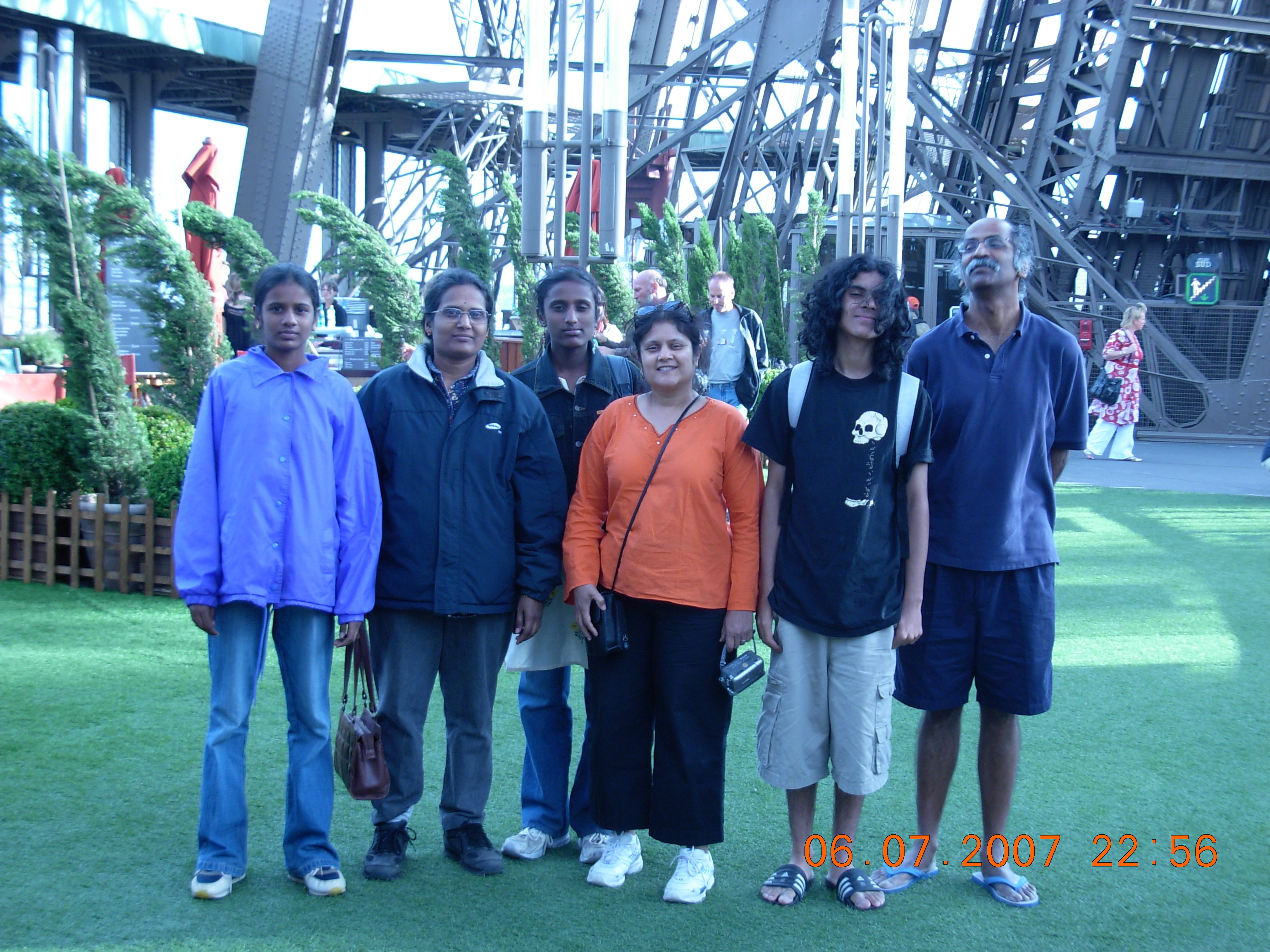
We could not believe this. We had both planned to spend the same weekend in Paris without knowing each others plan! We were pleasantly surprised and decided to spend the time in Paris together. It turned out we had booked hotels in different parts of Paris and were discussing about where to meet. When you want to meet someone in Paris, I thought the obvious choice would be to meet at the Eiffel Tower. We decided both our families will go to Eiffel tower in the evening of 6th July. Whoever reaches there first would wait on top of the tower for the other to join. We were nearing the entrance to the tower, when Prakash and family joined the queue. We waited for them to arrive and spend perhaps the best time of our lives going around Paris. A picture taken at the Eiffel tower with both our families reminds me of the miraculous trip we had in 2007. The time stamp has Indian Standard Time. Prakash is in his slipper, his usual footwear on all occasions.

It turned out that 9th July was the wedding anniversary for Prakash and Sujatha. We knew this and had packed a small gift for them. On 9th, as we were both getting ready to part ways, Prakash offered to give us a party. He was hesitant to reveal the reason and finally told us, “It is our wedding anniversary”! We smiled and gave them the small gift. Then, we took a train back to Rennes. Prakash and family were to take a flight next morning to the JFK airport New York. Prakash had done it often. Flying in to the east coast of the USA, visiting families and friends and driving from Manhattan, New York to Manhattan Kansas. Again after this trip, he started driving back to Kansas. When they were passing Pennsylvania, the misfortune struck us.

On the 9th July morning, we both visited, Sacré-Cœur, Paris. Anytime, I see a tower I like to climb to the top. Prakash and I were generally fit and never thought twice before exerting ourselves. We decided to climb up the Church building with our kids. I thought he looked more tired than I had ever seen him before. He had driven from Italy to Paris. We had been walking around Paris as if to utilize every minute we had in our hands. I thought, he may have been tired. I had no idea what was in store.

When I was back at the University of Rennes, I had an email from a common friend, another gem of a person, Youvaraj. Prakash had health problems and had to be hospitalized in Pennsylvania. He was diagnosed with Leukemia. I was stunned. We could not believe the miracle turning to misfortune so suddenly. Prakash survived till November 2008. He used this period to ensure that he would do everything that was needed for the survivors to lead a good life. He never complained about his health. He was always focused on what needs to be done. I managed to visit him during June 2008. That visit was another near miracle in itself. May be I will write about it on another occasion.

We live in a time of post-truth, over-coverage of negativity and many appear to have genuine concerns about the future of humanity and earth. I continue to remain positive. For I know, there are people like Prakash who never worry about themselves and do things for common good. In closing, let me share some part of an email I received from Prakash’s father C. S. Krishnaswami. “Prakash is always unforgettable and lives on to inspire his large circle of friends, relatives and students. He touched so many lives in his simple, selfless and self-effacing way. That is what we found out when we were in Manhattan. He himself never spoke of himself and of what he did.” I do not know if the father could ever tell this to his son. I do hope Prakash knew this! It is thanks to Prakash and many such noble souls, humanity and earth has survived for this long and I am sure they will continue to survive.


Standard