Uncategorized

My sister Meenakshi Bharathi, 1965-2026!

My sister Meenakshi Bharathi was born on 24 September 1965. She was married to her first cousin, Thiru Gnanam, on 1 November 1981. (1) She passed away exactly after completing 45 years of married life on 31 October 2026. This is exactly five weeks after my elder brother Thambi Durai passed away (2). She was five years younger to him and passed away five weeks after him. She had a son and two daughters and six grand childran, two each from her three wards. It might look like she had a full life. I wish she lived for two more decades enjoying the fruits of the hard labour of four and half decades.
I am the second son to our parents (3). After me, my mother had two girls (Vanathi and Meenakshi Bharathi) and then two boys (Sidharthan and Ramalingam). Meenakshi, as we called her, was the younger girl in the family. I remember her as a young, active, vociferous girl running around bubbling with enthusiasm. We lived in a compound, which had Aladi Sami Madam (2) and a big open area for us to play. There were two trees, one peeple and one neem and plenty of open area for the children to play. Though our house was small the area outside was large. The doors were never locked. Thinking back, we must have been poor but we never felt poor. There were days when our mother or an aunty would have a pot full of ‘kanji’ (old rice soaked in water) and some pickle and keep giving it to all the children sitting around in the open area outside our house.

Then one day, I vividly remember, Meenakshi was walking back from school somewhat shyish and looking tired around lunch time. She was accompanied by someone. She was a student at the OCPM Girls higher secondary school. I must have been in The American College for my PUC if my memory serves me right and was at home. Maybe she was 14 at that time. In our extended family, there was already talks about Vanathi being married to our maternal uncle (my mother’s younger brother). As I had mentioned in a blog on my parents (3), my mother was one of 10 surviving children, 5 boys and 5 girls. The family decided that a daughter of three elder sisters would be married to the three young brothers. My sister Vanathi married the youngest brother Shenbagamurthy, her maternal uncle, on 15 March 1981, when she was 17.

I learnt that, my father’s brother-in-law, my uncle had requested that our family give Meenakshi in marriage to his elder son, Thirugnanam even before Vanathi was married. My father had two sisters and this brother-in-law had married the elder one. She was elder to my father as well. They had five children, two sons and three daugthers. One daughter died very young and the others survived. My aunty passed away shortly after delivering the fifth child. My uncle then married another women and they had two sons and two daughters as well. This uncle with four sons and four daughters from two marriages was looking for a woman to come home as the eldest daughter-in-law, who would take care of the whole family. Except, Meenakshi was just around 15 at that time. My father loved his elder sister so much, he was committed to taking care of her children. In case you had read my blog on my parents, when my father was promised one seat in TVS High School, our cousin was admitted and my elder brother continued in A.C. High School near our home. Not surprisingly, my father agreed that Meenakshi would be married to my uncle’s eldest son when she just turned 16. She may have been informed and not consulted. I do not remember speaking up at that time. My elder brother informed me later in life that he did object to this.

Meenakshi was married when she was 16 and had three children in the next few years. She had a mother-in-law (second-wife of our uncle) who was not so friendly. Our mother asked Meenakshi to take care of Thriu Gnanam’s brothers and sisters from both mothers. I can imagine it must have been a major struggle for her in the initial years. After some period, Thiru Gnanam and Meenakshi started living in their own house, though smaller than where her father-in-law, his wife and children were living. Soon, Meenakshi assumed the role of the eldest daughter-in-law and took charge. Our family provided all the support as and when needed. Meenakshi and Thiru Gnanam worked hard and raised not only their 3 children but also took care of Thiru Gnanam’s brother, two sisters and also the two brothers and two sisters from father-in-law’s second family. Meenakshi had done everything to earn a living from preparing pickles to be sold, joining her husband in running businesses, selling oil, stamp papers, and taking care of the kids. I have another vivid memory of seeing Meenakshi running bare-foot in the ground in front of the Tallakulam Perumal Kovil. I felt bad watching her like this. They lived in a small street close to the temple.

Our uncle passed away long ago. Except for the elder sister of Thiru Gnanam, they conducted the wedding of everyone else in the family. Meenakshi accepted the role and worked very hard for her in-law’s family. Just a few months ago, I was talking to her husband Thiru Gnanam. He said: Meenakshi did everything and saved enough to conduct the many weddings. In her family, she became the matriarch and everyone listened to her. Leadership came to her naturally. In a way, she followed our mother’s footsteps and had the dominating presence in her family (3).

For several years, she had complained about gasping and was coughing a lot. Her condition was not diagnosed properly for more than a year. Eventually, we found out she had ‘systemic sclerosis’. Eventually it turned out to be scleroderma plus ild ( interstitial lung disease). When the diagnosis was done, her lung was already severly affected. She lived with continuous oxygen support for about two years. Her haemoglobin would drop drastically, requiring two units of blood every few weeks. Her daughter Subha took care of her continuously and tirelessly. When my brother passed away on 26 September 2026, after 10 days of ICU stay, Meenakshi was in a hospital getting bloods. Typically, she was given one unit in an afternoon and another unit in the next morning. She was keen on seeing my brother one last time. We waited for her to come home after blood transfusion. She came to him and said: I thought you would see me off! She did not cry and some relatives found it strange. One person could not resist asking her. Her response: No tears left!.

In the last two years or so, after the blood transfusion, Meenakshi was taken to her home, in the first floor of a building, and rested in her bed. Though she could not move around freely, she stayed there in reasonable comfort until the next units of blood were needed. This routine was affected when my brother passed away as she came to his house which was far away. When she returned to her home next morning, she could not climb up and struggled. She was admitted in a hospital and recovered slowly after a week. However, since that day, her health detiorated and she breathed her last on 31st October 2026 around 0030 hours. As I write this the day before Deepavali in 2026, I remember the joyous Deepavali we had last year in Madurai. Though, Meenakshi was suggested that she should not go out anywhere, she wanted to came to our home in Madurai and joined the Deepavali celebrations. All six of us were there with all our family members. We are two less now! My elder brother took charge as the eldest in the family and cared for everyone. My younger sister became the eldest daughter-in-law in my uncle’s family and took charge and cared for everyone.

  1. In 1978, India amended the Child marriage restraint act, 1929 to increase the legal age of marriage from 15 to 18 for a female and 18 to 21 for a male. This would make my sister’s marriage illegal in 1981.
  2. https://earunan.org/2026/10/28/aaladi-saami-madam-and-aaladi-thambidhurai/ (accessed on 7 November 2026)
  3. https://earunan.org/2024/01/23/my-parents-%e0%ae%8e%e0%ae%a9%e0%af%8d-%e0%ae%aa%e0%af%86%e0%ae%b1%e0%af%8d%e0%ae%b1%e0%af%8b%e0%ae%b0%e0%af%8d-en-petror/ (Accessed on 7 November 2026)
Standard
Family

My parents: என் பெற்றோர் (En petRor)

My father was born in 1937 in Tallakulam, Madurai to Gurunathapandara Mudaliar and Kamalayee ammal. He was named Aaladi. We had a ‘jeevasamaadhi’ (a grave in which someone alive is buried based on that person’s wish) which was called Aaladi Saami Madam (Saami in Tamil could mean God or Godmen) right next to where he and I were born. Aaladi was a cousin of my great grand-father Nallathambi Mudaliar. My father was born in the family of ‘kaariyakkaarar’, perhaps like a ‘Secretary’ for the group of people in that neighbourhood. This responsibility came by birth. Nallathambi Mudaliar did a lot for the society and when he passed away, the locals insisted that he be buried in their neighbourhood, Parasurampatti in Madurai. We visit his Samadhi twice a year, during Pongal and Chitra festival as a family and pray. He fought in a local election, perhaps to serve the people more but lost the election. Moreover, he lost almost all our wealth in this process as well. My grandfather, Gurunathapandara mudaliar, was a man of principle. He ensured that all loans were settled with interest and my father could start from zero rather than being negative. My father was in pre-University when my grand-father passed away and the responsibility for the family fell on his shoulders at that young age. He joined the small business (cloth merchants) we had. He was an excellent football player and has represented school and played in the city tournaments. His education and football came to a grinding halt after he lost his father. All his life he worked to ensure that the family survived and grew. As we grew, he did a lot to ensure that all our relatives, neighbours, community, and anyone and everyone he got to know could grow. He encouraged everyone to get a good education and work hard.

My mother Chellammal alias Seetha was born to Kulandaivelu Mudaliar (chinna thatha) and Paappammaal in 1941. Kulandaivelu Mudaliar’s elder brother was Sellachaami Mudaliar (periya thatha), who was a born-leader. My mother was one of the five girls born to their parents along with five boys. There could have been a few more babies that did not survive. On the contrary, Sellachaamy Mudaliar and his wife Parattai had only one daughter. Both brothers lived as joint family and all eleven kids lived like having two fathers and two mothers. Periya thatha was the care-taker for the family who made the final decision for the family. They lived in a big bungalow, with two floors and an open-terrace and prayer room in the third floor. This was in the Old Agraharam in Chinna Chokkikulam, just about a km from our ancestral ‘home’. My father was living in a mud-house with tin-sheets on top and there was perhaps only one room with a kerosene stove in the corner. There was no attached bathroom/toilet. We had a well in that area and several other huts. Periya thatha decided that my mother would be married to my father, though the difference in their financial status was huge. My father’s family had a reputation which periya thatha was well aware off. He not only got them married, but also got my father initiated in a new business, as a petroleum dealer.

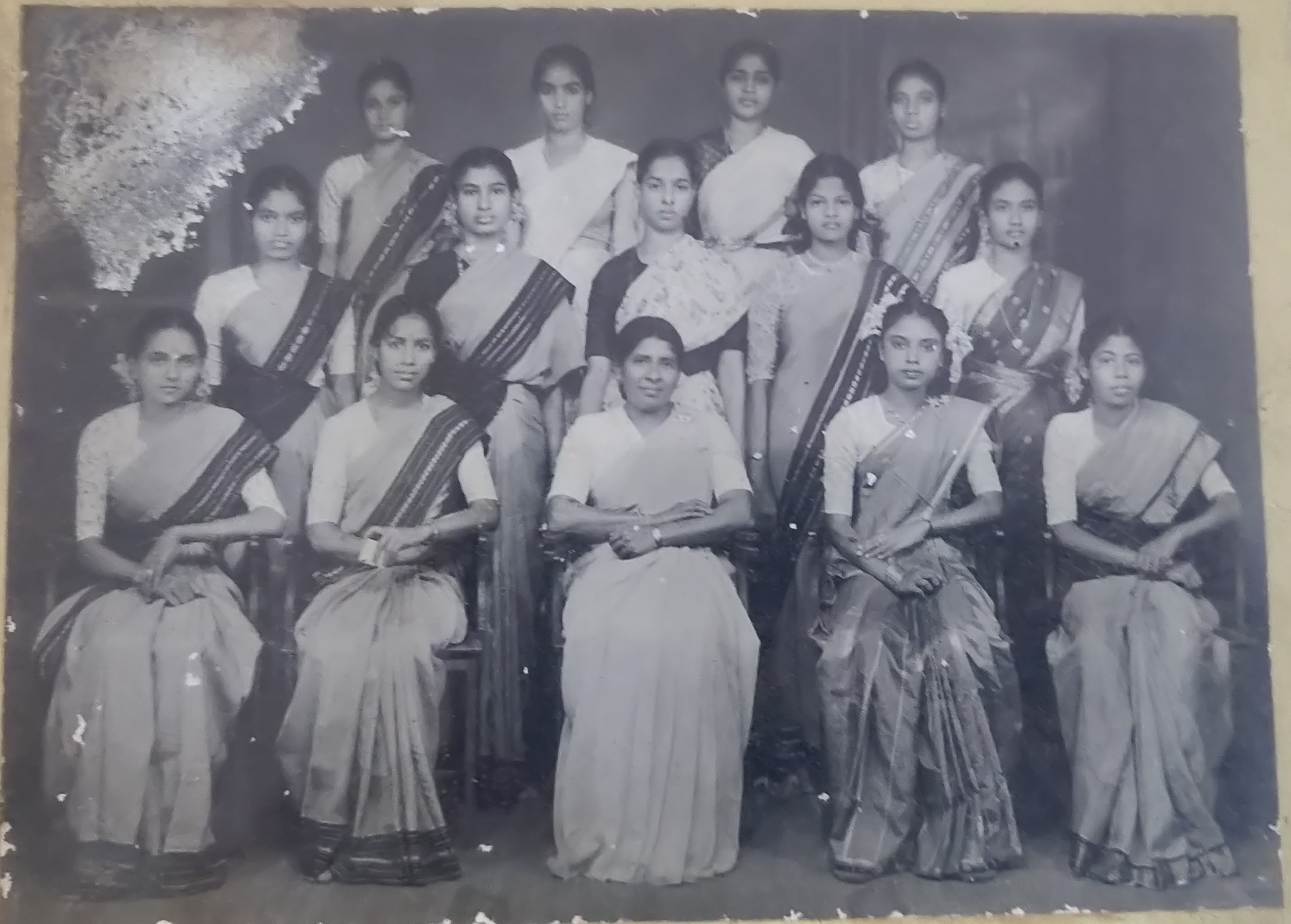
Before marriage, my father excelled in football and took active interest in the Dravidian politics. He voted positively in the Trichi conference of the newly found DMK in their referundum to decide whether to become a political party or remain as social organization like it’s predecssor DK. When he joined pre-university, he decided to give himself a new name. He liked Balakrishnan but did not want to give a ‘sanskrirtized’ name. He called himself Elangannan (இளங்கண்ணன்) which means the same in Tamil. In Tamilnadu, by then people stopped adding caste name as their last name. Kids were given a name and an initial that came from their father’s name. Hence, my father became G. Elangannan and I became E. Arunan. This is continuing to cause problems for people born in this state as they need to give a first/given name and last/family name everywhere else in India/abroad. My father is third from the left in the top row.

My mother before marriage grew up in the big bungalow. Sellachaamy Mudaliar was very close to Swami Sithbavaananda who ran the Ramakrishna Matt in Thirupparaithurai, near Trichi, called Tapovanam. Swami always stayed in their bungalow when visiting Madurai. Tapovanam ran a boarding school in which all five of my uncles studied until their pre-University. My mother studied in a school in Madurai and excelled in her studies. She got a state-rank in her school final year. My mother is second in the middle row from left.

My mother’s studies ended on getting married to my father in 1959. In addition to the huge differences in their background, my father was a non-vegetarian and my mother was a vegetarian. My mother learned to cook non-vegetarian food as well. Though my father’s family was as religious as every other family those days, my father grew up following the self-respect/Dravidian movements. We have heard that he refused to give a horoscope for checking before their marriage. He named their first son as Thambidhurai and me as Arunan. The third child, a girl was named Vanathi and all these were typical names given by the people involved in the political movement. Their fourth child was a girl as well and my mother preferred to name her Meenakshi, the Goddess whose name invariably follows Madurai, and my father wanted her to be named Bharathi. With a compromise, my second sister became Meenakshi Bharathi, and everyone called her Meenakshi (this is one of the reasons I chose Bharathi as the name of my first daughter). Sellachamy Mudaliar and Chellammal’s influence on my father transformed him dramatically and he became a staunch devotee and a committed family man conscious of his societal responsibilities. The two boys born after Meenakshi were named Sidharthan and Ramalingam.

On Mondays he would not leave home between 7:30 AM and 9:00 AM, as this is considered Ragu kala, an inauspicious time to start anything. His daily routine was leaving home before 8 AM and reaching home around 9 PM. He liked to have a chikki (a sweet toffy made of groundnut and jaggery called kadalai mittai in Tamil) and some betel leaves in the night. I used to go to a petty shop after he comes home to buy these. Those days, buying them in packets and storing them for days or weeks was not common. This was done everyday! As children, we rarely got time to spend with him but could always feel his presence. There was a stick visible at home which was used to warn us by mother at home: Appa will beat you with that stick! I grew up in a time when children aged 5 or more joined 1st Standard in a School. I did my first year of School at Nehru Vidhyalaya in Madurai. My elder brother was already in that school. We were both moved to a school formed by our community in Tallakulam in which my grandfather and father were actively involved. My father learned about T.V.S. Elementary School and felt we should be moved there. He met the school principal repeatedly pleading for admission to his family kids. One year the Principal agreed to admit one student brought by him. He decided to put his elder sister’s son instead of my elder brother in TVS School. His elder sister, my aunt was no more and he felt that her son should be given priority. He continued to visit TVS School pleading to admit his sons/nephews and eventually I was admitted in the 5th Standard. Indeed, that took me to where I am today. That was my third and final school and I had not gone to a kinder garden or pre-school. During the summer holidays after 5th, I was enjoying the vacation and had forgotten that I had to go to school for securing admission to 6th, which was in their High School. I still remember my father coming home during the day reminding me and taking me to the school in his scooter.

My mother was always home and she taught us everything. My handwriting has never been good. I had difficulty in writing 2 after 1 and I remember my mother sitting with me with a slate and chalk and helping me write 2. Discipline was taught from the beginning. I remember winning some lottery, 50 paise during my elementary school days when one Dosai was 20 paise. I told my elder brother and we both went to a hotel near our home to have Dosai. Our mother found this out and when we returned home in the evening, we were beaten heavily for venturing out to a hotel on our own. She told us stories like Ramayanam and Mahabharatham. We learned Thevaram and Thiruvasagam and recited them in the morning and evening. Particularly, in our grand father’s house there was a prayer every morning and evening when all of us would sit and recite these devotional songs for about half an hour. The prayer hall had a photo of all our major Gods, including one of Jesus and Mecca.

My father used to tell us several things as a common wise man from his experience. A few of them I remembered and followed. I do owe whatever I could achieve to these three things (they sound and rhyme better in Tamil and I have given it in Tamil for those who can read): 1. Even if your ship sinks, do not worry (கப்பலே கவுந்தாலும் கன்னத்திலே கை வைக்கக் கூடாது kappalae kavunthaalum kannathilae kaivaikka koodaathu); 2. Let us tie our hair and pull a hill, if it comes it’s a hill and if not we only lose a hair (மயிரைக் கட்டி மலையை  இழுப்போம் வந்தா மலை போனா மயிர், mayiraik katti malayai iluppom, vanthaa malai ponaa mayiru). 3. If we go to a town where everyone is eating crab, ask for the middle piece (நண்டு திங்கிறவங்க ஊருக்குப் போனா, நடுத்துண்டு எனக்கு வேணும்னு கேளு, nandu thingiravan oorukkup ponaa, naduthundu enakku venumnu kaelu). The first one convinced me that I would never worry about anything and focus on what I can do at any given situation. The second one convinced me of the importance of trying our best without worrying about the prospects. And the third one taught me to adapt to the local environment. It helped me live with peace and joy wherever I lived. It is well known as ‘while in Rome do what Romans do’.

My mother’s influence is difficult to write in a few sentences like this. She was always there for us and worked tirelessly. I realized that among our age-group boys, we were perhaps the only ones not to utter any common curse words one hears in every language, everywhere. In general, all of us were well behaved students in the school. Anything we needed, Amma was the first person to be approached.  My father and his younger brother (Nalla Thambi Chithappa) lived as a joint family as well. He and his wife Rajeswari had four children. I remember vividly one day, my chitthappa was carrying the body of a baby within a few days after birth. In 1970, my father, with the support of periya thatha, built 8 houses in a row with tiles on top. Each house had an entrance, a hall and a kitchen. All the eight houses at the end had a continuous 3 feet service area and we had three toilets for the 8 families at the end. Appa and chithappa stayed in the middle two houses which were joined and the other 6 houses were rented. Men and children would take bath right behind the houses, where there was a water tap. Women in the house would all take bath after sending the men to work and children to school. A compound wall separating our houses from the TVS Sangeetha Samajam was there on the other side and there was no roof to this service area. We lived in this house until 1981, when my parents moved to an independent house having toilets at the backside.

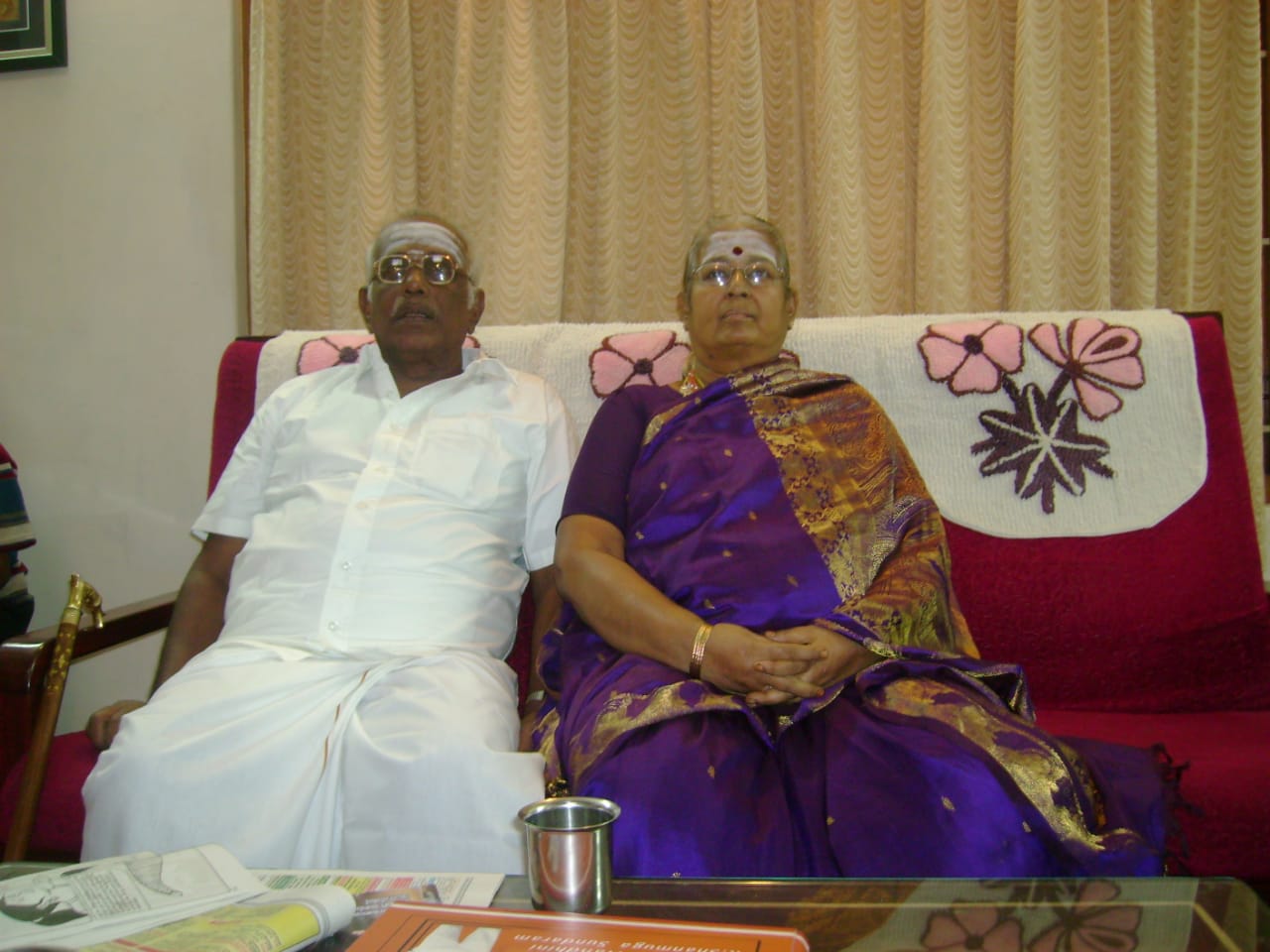
I went to USA in 1986 for my PhD and my wife, Thenmozhi alias Gomathi joined me in 1990 when we got married. We had our first daughter born in February 1994 in Urbana. My mother came to USA before delivery and was with us for close to 9 months. My father joined after I got the job at IIT Kanpur. I called him to inform about the job offer and asked him to visit us. I told him that we are returning for good and that would be an ideal time for him to visit USA. Somewhat coincidentally, USA was hosting World Cup Soccer that year. His first response: If you can take me to world cup soccer, I will come. Until then, I was not thinking about going to a game, though in Madurai I used to get season ticket to watch the football tournament every year. I did not know if tickets were available at that time. I told him that, I would try but he should visit us whether or not I succeed. I disconnected the call and called the number available for booking world cup tickets. “Hello, this is World Cup Soccer ticket booking online, can I help you?” “Yes I would like to buy tickets for the Spain-Bolivia game in Chicago” “I can help you with that, how many tickets do you need?” I was not expecting to hear this. I knew Appa and I would go. Would anyone else among my friends be interested? I answered 4! “Here is your confirmation number. Come to the stadium two hours before the game and collect your tickets”. I could not believe it. I called my father immediately and told him: I got the tickets, plan your travel. Then I called some of my friends and asked them: World cup tickets for the game in Chicago are available, are you interested? In a few minutes we needed 10 more tickets. I called the helpline again and I was told: Sold out! My parents during a visit to Niagara Falls in 1994.

My parents complemented each other very well and our house was always full. All our cousins, their friends, and our friends were all at our home almost on a daily basis. My mother cooked delicious food, snacks, made coffee any time and all the time. My father would encourage all of them to do well and enhance our skills. Both of them would host everyone with smiling faces. My father was very active in business associations, our temple priests association, Socio Economic Society (SES, which was formed to help people from our community) and any and all groups he was part of. Our ‘kula theivam’ family god is Sithar in Puliyuran village near Aruppukottai. All those having Sithar as kula theivam come from one clan and they are called ‘pangaali’s, translated as share holders in English. As it may have been typical, in some generation, two brothers must have had an irreconcilable difference and their families and generations since became arch-rivals. Since then we have our pangaalis and ethir-pangaalis (opposite group). The most important festival we celebrated was Sivarathiri. The two groups came to an agreement that they will celebrate the festival and take care of the temple in alternate years. Two groups do nothing together, except on the Tamil New Year day, they would assemble in the Temple and exchange keys. My father did a lot to unite the two factions and now I see more interactions between the two groups. My mother remained the backbone supporting him in everything.

My mother passed away on 18th April 2014, during the Chitra Festival after 55 years of married life. My father passed away on 17th January 2024, during the Pongal Festival. These were the two festivals during which we visit our great grand-father’s samadhi in Parasurampatti. I would have yet another important reason to visit Madurai during these festivals. Today’s generation may not be able to appreciate what they did in their life, starting from agreeing to get married to an ‘incompatible stranger’! They accepted each other whole-heartedly and lived a great life. They have together, raised not only our family, they have raised a village. None of us could have done what we did eventually in our life without their hard-work, unflinching support, love and care. In Tamil, there is a saying ‘annaiyum pithavum munnari theivam’ which translates to ‘mother and father are the primary gods’. In Sanskrit, the saying goes ‘Matha, pitha, guru, theivam’. We have been fortunate to have our primary gods as ideal parents.

Standard