May 15 happens to to be the international day for families. This year it was right in the middle of our Ph.D. interview week and I could not write this blog. I started it later and finally decided to complete this on 31st December 2024 as the world is anxious about the uncertainties all over. We have more than two wars. Election results in USA and several other countries and states in India have been of concern to some who consider themselves as liberals. Rebecca Trager has written a commentary in Chemistry World titled, ‘Trump is a disaster for Science’.1 I am reminded of a blog I wrote in 2017 after Trump won the first term and Modi demonetized Indian currency that led to disaster for numerous poor people in India.2 Clearly, New York Times would not accept 2016 to be the worst year ever. I suspect they would dub 2024 as the worst year.
In every nation and in every society, the importance of a family has been recognized. Liberal philosophers have always pointed out that all humanity is one family. I have mentioned an ancient poem in Tamil written by Kaniyan Poongundranaar which proclaims ‘yaadum oorae yaavarul kaeLir’ (“யாதும் ஊரே யாவரும் கேளிர்”), which means all towns are our town and all people are our relatives. When India became the head of G20 recently, the slogan ‘Vasudeva kudumbakam’ (written in Hindi in the image below) was chosen which means ‘the world is one family’.
While these are esoteric ideas, everyone knows what is practically meant by a family. I think family means, love, affection, duty and right (in Tamil காதல், பாசம், கடமை, உரிமை, kaathal, paasam, kadamai and urimai) among the members of the family and I must add in reasonable measures. Anything in excess cannot be good. The esoteric ideas pointed out above can be taken to mean that there is no need to hate anyone and we should all learn to live and let live. There is a proverb in Tamil which says “தனக்கு மிஞ்சி தான் தான தர்மம் (thanakku minji thaan thaana tharmam)”, which means you can help others and donate what you have after keeping what you need. I think this is applicable for time as well. Unfortunately, this does not tell you what one needs and that is upto the individual to decide. It is worth remembering what Gandhi said: “There is enough in this world for everyone’s need, not enough for a single man’s greed”.
A typical family, for me, starts with a husband and wife, who take a vow to share the good and bad life will bring. In typical marriages in India, this vow is implied and is not spoken loud.3 Whether the marriage is arranged by family or the individuals who are already in love with each other, this vow is important. Love and affection between them are necessary but not sufficient. There is an old proverb in Tamil which says ‘mogam muppathu naal, aasai arubathu naal (infatuation lasts for 30 days and desire lasts for 60 days). Life lasts much longer. It is important for the husband and wife to take responsibility in each others lives and also the liberty to expect help from each other as and when needed. It would be naive to assume that the husband and wife live happily ever after the marriage. Good and bad times will come. Facing them together, enjoying the good times and sailing through the bad times are essential. Love and affection could help in doing this for some time. If one does not recognize the importance of the duty and right that come with marriage, sailing together becomes difficult, especially when the going gets tough. Now, one can see how world as one family is not practical.
The major challenge for humans in a family, is balancing the interests of self and other members of the family. Between husband and wife, as equal partners, this is important from day one. Neither can expect the other person to take care of him/her all the time and it is important to give space and time for the other person. There will be situations in which one member has to do more and by nature there will be situations in which the roles reverse. With children, until they grow up, parents have to provide everything. Unlike the husband-wife relation which is expected to be that of equals, parents-children relation is typically, and rightfully, one sided. We need to take full responsibility for our children until they grow to be independent adults. Often unconditional love and support are given to children by parents. As the children grow and learn to take care of themselves, slowly some responsibility for the family falls on their shoulder. While most humans do feel sympathy when looking at everyone who is suffering, taking responsibility for everyone who suffers is impossible for anyone. Within a family, it is a responsibility and duty to do this. This is expected in a typical family and this cannot be applied to ‘vasudeva kudumbakam’. However, parents should not force or expect their children to be with them and help them always and let them do what they want in their life. In my view, parents are responsible for the children who are brought to this world by their act. This needs to be one-sided relation. Ultimately, the children have to move on and start their families.
I am convinced that every society recognized the importance of the duty and right that come with marriage. In India, Hinduism (broadly encompassing all religions originated and grew in India, perhaps except Sikhism, Jainism and Buddhism) emphasized this. The most popular poet from Tamil cinema, Kannadasan, wrote several volumes titled ‘arthamulla indu matham (அர்த்தமுள்ள இந்து மதம்)’ translated as ‘The meaningful Hindu religion’. and there is a popular song of him that begins with these words. It starts by saying ‘the meaningful Hindu religion assigned duties for every human’. This includes duties to the family and also to the society, as every human has several roles to play. Thirukkural in Tamil has a chapter each, outlining the roles of different individuals as well. When one recognizes and accepts the importance of duty and right, this continues for life, and members of the family have to do it without any expectation.
Bhagavad Gita emphasized doing one’s duty without expecting anything in return. This is a deep thought that most would accept individually. However, in practice this can be used for exploitation. Ideally, every one should have the liberty to choose what is his/her duty. However, once chosen, (s)he has to remain dutyful. There will be times when some in the family feel others are not doing their part. This could be real or perceived. It would be human nature to exaggerate one’s own contributions. It would be good to have an open discussion and sort these issues out through discussion. It is important for both parties to talk AND listen. Family is an important unit for humans and every attempt to preserve it is essential in my view. As long as family survives, the humanity can survive. Any attempts to dislodge the family structure would be viewed with skepticism by people at large. Perhaps that explains some of the election results. I wish everyone a happy, healthy, peaceful and prosperous new year!
References:
Rebecca Trager, Trump is a disaster for Science, Chemistry World, page 6, December 2024 issue.
I found this vow on the web: “I take you to be my wife/husband, to have and to hold from this day forward; for better, for worse, for richer, for poorer, in sickness and in health, to love and to cherish, till death us do part”. There is a beautiful Tamil film song from Vinnaithaandi Varuvaaya which has this vow. https://www.youtube.com/watch?v=bXa-wbiXiOw In case you know this song, the first line is worth remembering and it is equally important to realize that the second line implies blind love, that cannot last forever. If it does, it is comparable to fatal attraction.
My father was born in 1937 in Tallakulam, Madurai to Gurunathapandara Mudaliar and Kamalayee ammal. He was named Aaladi. We had a ‘jeevasamaadhi’ (a grave in which someone alive is buried based on that person’s wish) which was called Aaladi Saami Madam (Saami in Tamil could mean God or Godmen) right next to where he and I were born. Aaladi was a cousin of my great grand-father Nallathambi Mudaliar. My father was born in the family of ‘kaariyakkaarar’, perhaps like a ‘Secretary’ for the group of people in that neighbourhood. This responsibility came by birth. Nallathambi Mudaliar did a lot for the society and when he passed away, the locals insisted that he be buried in their neighbourhood, Parasurampatti in Madurai. We visit his Samadhi twice a year, during Pongal and Chitra festival as a family and pray. He fought in a local election, perhaps to serve the people more but lost the election. Moreover, he lost almost all our wealth in this process as well. My grandfather, Gurunathapandara mudaliar, was a man of principle. He ensured that all loans were settled with interest and my father could start from zero rather than being negative. My father was in pre-University when my grand-father passed away and the responsibility for the family fell on his shoulders at that young age. He joined the small business (cloth merchants) we had. He was an excellent football player and has represented school and played in the city tournaments. His education and football came to a grinding halt after he lost his father. All his life he worked to ensure that the family survived and grew. As we grew, he did a lot to ensure that all our relatives, neighbours, community, and anyone and everyone he got to know could grow. He encouraged everyone to get a good education and work hard.
My mother Chellammal alias Seetha was born to Kulandaivelu Mudaliar (chinna thatha) and Paappammaal in 1941. Kulandaivelu Mudaliar’s elder brother was Sellachaami Mudaliar (periya thatha), who was a born-leader. My mother was one of the five girls born to their parents along with five boys. There could have been a few more babies that did not survive. On the contrary, Sellachaamy Mudaliar and his wife Parattai had only one daughter. Both brothers lived as joint family and all eleven kids lived like having two fathers and two mothers. Periya thatha was the care-taker for the family who made the final decision for the family. They lived in a big bungalow, with two floors and an open-terrace and prayer room in the third floor. This was in the Old Agraharam in Chinna Chokkikulam, just about a km from our ancestral ‘home’. My father was living in a mud-house with tin-sheets on top and there was perhaps only one room with a kerosene stove in the corner. There was no attached bathroom/toilet. We had a well in that area and several other huts. Periya thatha decided that my mother would be married to my father, though the difference in their financial status was huge. My father’s family had a reputation which periya thatha was well aware off. He not only got them married, but also got my father initiated in a new business, as a petroleum dealer.
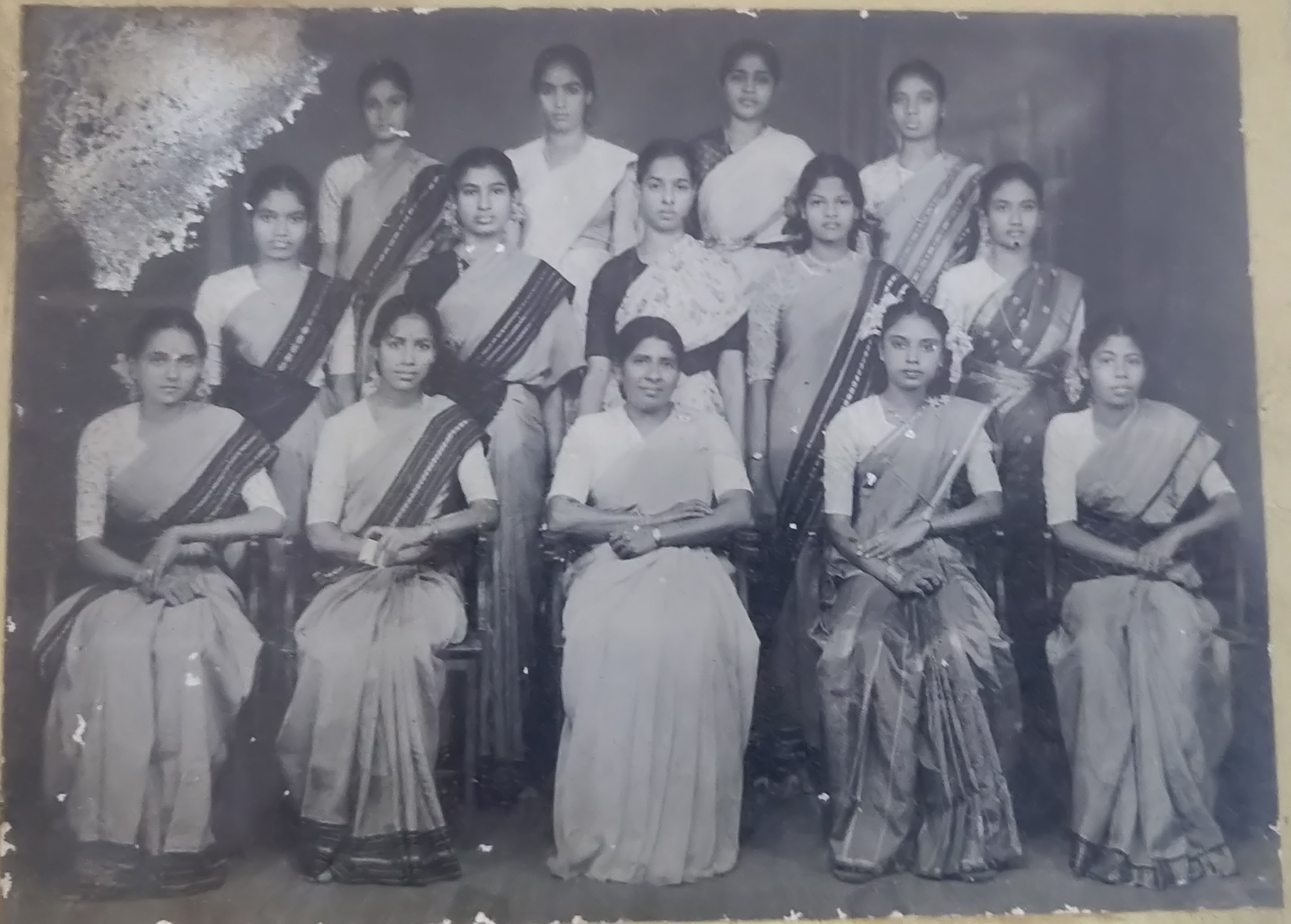
Before marriage, my father excelled in football and took active interest in the Dravidian politics. He voted positively in the Trichi conference of the newly found DMK in their referundum to decide whether to become a political party or remain as social organization like it’s predecssor DK. When he joined pre-university, he decided to give himself a new name. He liked Balakrishnan but did not want to give a ‘sanskrirtized’ name. He called himself Elangannan (இளங்கண்ணன்) which means the same in Tamil. In Tamilnadu, by then people stopped adding caste name as their last name. Kids were given a name and an initial that came from their father’s name. Hence, my father became G. Elangannan and I became E. Arunan. This is continuing to cause problems for people born in this state as they need to give a first/given name and last/family name everywhere else in India/abroad. My father is third from the left in the top row.
My mother before marriage grew up in the big bungalow. Sellachaamy Mudaliar was very close to Swami Sithbavaananda who ran the Ramakrishna Matt in Thirupparaithurai, near Trichi, called Tapovanam. Swami always stayed in their bungalow when visiting Madurai. Tapovanam ran a boarding school in which all five of my uncles studied until their pre-University. My mother studied in a school in Madurai and excelled in her studies. She got a state-rank in her school final year. My mother is second in the middle row from left.
My mother’s studies ended on getting married to my father in 1959. In addition to the huge differences in their background, my father was a non-vegetarian and my mother was a vegetarian. My mother learned to cook non-vegetarian food as well. Though my father’s family was as religious as every other family those days, my father grew up following the self-respect/Dravidian movements. We have heard that he refused to give a horoscope for checking before their marriage. He named their first son as Thambidhurai and me as Arunan. The third child, a girl was named Vanathi and all these were typical names given by the people involved in the political movement. Their fourth child was a girl as well and my mother preferred to name her Meenakshi, the Goddess whose name invariably follows Madurai, and my father wanted her to be named Bharathi. With a compromise, my second sister became Meenakshi Bharathi, and everyone called her Meenakshi (this is one of the reasons I chose Bharathi as the name of my first daughter). Sellachamy Mudaliar and Chellammal’s influence on my father transformed him dramatically and he became a staunch devotee and a committed family man conscious of his societal responsibilities. The two boys born after Meenakshi were named Sidharthan and Ramalingam.
On Mondays he would not leave home between 7:30 AM and 9:00 AM, as this is considered Ragu kala, an inauspicious time to start anything. His daily routine was leaving home before 8 AM and reaching home around 9 PM. He liked to have a chikki (a sweet toffy made of groundnut and jaggery called kadalai mittai in Tamil) and some betel leaves in the night. I used to go to a petty shop after he comes home to buy these. Those days, buying them in packets and storing them for days or weeks was not common. This was done everyday! As children, we rarely got time to spend with him but could always feel his presence. There was a stick visible at home which was used to warn us by mother at home: Appa will beat you with that stick! I grew up in a time when children aged 5 or more joined 1st Standard in a School. I did my first year of School at Nehru Vidhyalaya in Madurai. My elder brother was already in that school. We were both moved to a school formed by our community in Tallakulam in which my grandfather and father were actively involved. My father learned about T.V.S. Elementary School and felt we should be moved there. He met the school principal repeatedly pleading for admission to his family kids. One year the Principal agreed to admit one student brought by him. He decided to put his elder sister’s son instead of my elder brother in TVS School. His elder sister, my aunt was no more and he felt that her son should be given priority. He continued to visit TVS School pleading to admit his sons/nephews and eventually I was admitted in the 5th Standard. Indeed, that took me to where I am today. That was my third and final school and I had not gone to a kinder garden or pre-school. During the summer holidays after 5th, I was enjoying the vacation and had forgotten that I had to go to school for securing admission to 6th, which was in their High School. I still remember my father coming home during the day reminding me and taking me to the school in his scooter.
My mother was always home and she taught us everything. My handwriting has never been good. I had difficulty in writing 2 after 1 and I remember my mother sitting with me with a slate and chalk and helping me write 2. Discipline was taught from the beginning. I remember winning some lottery, 50 paise during my elementary school days when one Dosai was 20 paise. I told my elder brother and we both went to a hotel near our home to have Dosai. Our mother found this out and when we returned home in the evening, we were beaten heavily for venturing out to a hotel on our own. She told us stories like Ramayanam and Mahabharatham. We learned Thevaram and Thiruvasagam and recited them in the morning and evening. Particularly, in our grand father’s house there was a prayer every morning and evening when all of us would sit and recite these devotional songs for about half an hour. The prayer hall had a photo of all our major Gods, including one of Jesus and Mecca.
My father used to tell us several things as a common wise man from his experience. A few of them I remembered and followed. I do owe whatever I could achieve to these three things (they sound and rhyme better in Tamil and I have given it in Tamil for those who can read): 1. Even if your ship sinks, do not worry (கப்பலே கவுந்தாலும் கன்னத்திலே கை வைக்கக் கூடாது kappalae kavunthaalum kannathilae kaivaikka koodaathu); 2. Let us tie our hair and pull a hill, if it comes it’s a hill and if not we only lose a hair (மயிரைக் கட்டி மலையை இழுப்போம் வந்தா மலை போனா மயிர், mayiraik katti malayai iluppom, vanthaa malai ponaa mayiru). 3. If we go to a town where everyone is eating crab, ask for the middle piece (நண்டு திங்கிறவங்க ஊருக்குப் போனா, நடுத்துண்டு எனக்கு வேணும்னு கேளு, nandu thingiravan oorukkup ponaa, naduthundu enakku venumnu kaelu). The first one convinced me that I would never worry about anything and focus on what I can do at any given situation. The second one convinced me of the importance of trying our best without worrying about the prospects. And the third one taught me to adapt to the local environment. It helped me live with peace and joy wherever I lived. It is well known as ‘while in Rome do what Romans do’.
My mother’s influence is difficult to write in a few sentences like this. She was always there for us and worked tirelessly. I realized that among our age-group boys, we were perhaps the only ones not to utter any common curse words one hears in every language, everywhere. In general, all of us were well behaved students in the school. Anything we needed, Amma was the first person to be approached. My father and his younger brother (Nalla Thambi Chithappa) lived as a joint family as well. He and his wife Rajeswari had four children. I remember vividly one day, my chitthappa was carrying the body of a baby within a few days after birth. In 1970, my father, with the support of periya thatha, built 8 houses in a row with tiles on top. Each house had an entrance, a hall and a kitchen. All the eight houses at the end had a continuous 3 feet service area and we had three toilets for the 8 families at the end. Appa and chithappa stayed in the middle two houses which were joined and the other 6 houses were rented. Men and children would take bath right behind the houses, where there was a water tap. Women in the house would all take bath after sending the men to work and children to school. A compound wall separating our houses from the TVS Sangeetha Samajam was there on the other side and there was no roof to this service area. We lived in this house until 1981, when my parents moved to an independent house having toilets at the backside.
I went to USA in 1986 for my PhD and my wife, Thenmozhi alias Gomathi joined me in 1990 when we got married. We had our first daughter born in February 1994 in Urbana. My mother came to USA before delivery and was with us for close to 9 months. My father joined after I got the job at IIT Kanpur. I called him to inform about the job offer and asked him to visit us. I told him that we are returning for good and that would be an ideal time for him to visit USA. Somewhat coincidentally, USA was hosting World Cup Soccer that year. His first response: If you can take me to world cup soccer, I will come. Until then, I was not thinking about going to a game, though in Madurai I used to get season ticket to watch the football tournament every year. I did not know if tickets were available at that time. I told him that, I would try but he should visit us whether or not I succeed. I disconnected the call and called the number available for booking world cup tickets. “Hello, this is World Cup Soccer ticket booking online, can I help you?” “Yes I would like to buy tickets for the Spain-Bolivia game in Chicago” “I can help you with that, how many tickets do you need?” I was not expecting to hear this. I knew Appa and I would go. Would anyone else among my friends be interested? I answered 4! “Here is your confirmation number. Come to the stadium two hours before the game and collect your tickets”. I could not believe it. I called my father immediately and told him: I got the tickets, plan your travel. Then I called some of my friends and asked them: World cup tickets for the game in Chicago are available, are you interested? In a few minutes we needed 10 more tickets. I called the helpline again and I was told: Sold out! My parents during a visit to Niagara Falls in 1994.
My parents complemented each other very well and our house was always full. All our cousins, their friends, and our friends were all at our home almost on a daily basis. My mother cooked delicious food, snacks, made coffee any time and all the time. My father would encourage all of them to do well and enhance our skills. Both of them would host everyone with smiling faces. My father was very active in business associations, our temple priests association, Socio Economic Society (SES, which was formed to help people from our community) and any and all groups he was part of. Our ‘kula theivam’ family god is Sithar in Puliyuran village near Aruppukottai. All those having Sithar as kula theivam come from one clan and they are called ‘pangaali’s, translated as share holders in English. As it may have been typical, in some generation, two brothers must have had an irreconcilable difference and their families and generations since became arch-rivals. Since then we have our pangaalis and ethir-pangaalis (opposite group). The most important festival we celebrated was Sivarathiri. The two groups came to an agreement that they will celebrate the festival and take care of the temple in alternate years. Two groups do nothing together, except on the Tamil New Year day, they would assemble in the Temple and exchange keys. My father did a lot to unite the two factions and now I see more interactions between the two groups. My mother remained the backbone supporting him in everything.
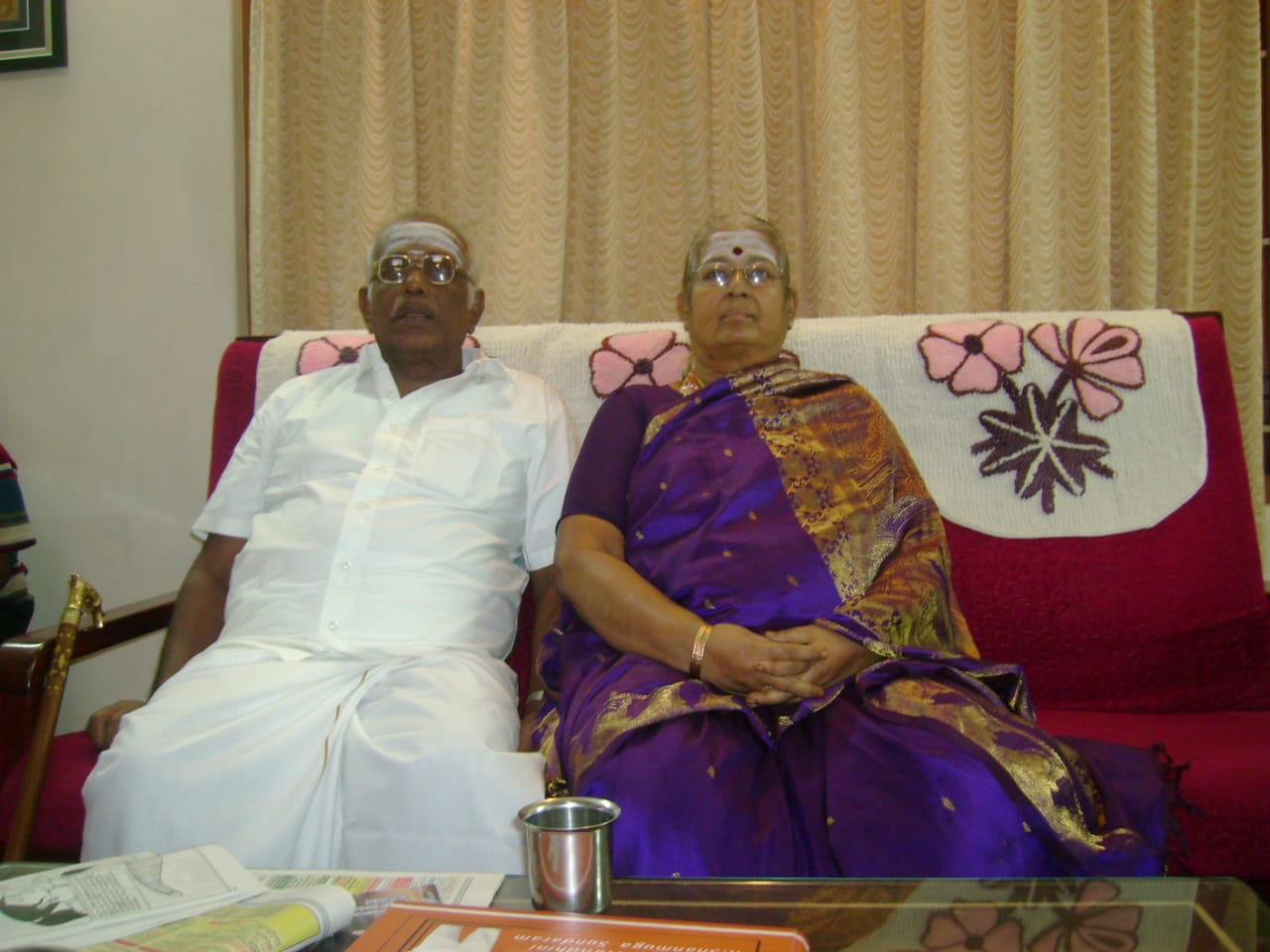
My mother passed away on 18th April 2014, during the Chitra Festival after 55 years of married life. My father passed away on 17th January 2024, during the Pongal Festival. These were the two festivals during which we visit our great grand-father’s samadhi in Parasurampatti. I would have yet another important reason to visit Madurai during these festivals. Today’s generation may not be able to appreciate what they did in their life, starting from agreeing to get married to an ‘incompatible stranger’! They accepted each other whole-heartedly and lived a great life. They have together, raised not only our family, they have raised a village. None of us could have done what we did eventually in our life without their hard-work, unflinching support, love and care. In Tamil, there is a saying ‘annaiyum pithavum munnari theivam’ which translates to ‘mother and father are the primary gods’. In Sanskrit, the saying goes ‘Matha, pitha, guru, theivam’. We have been fortunate to have our primary gods as ideal parents.
Some of the recent happenings, which influenced me significantly, led me to think about gravity and love. While I cannot mention all those things in this blog, I should point out two. One is the last blog I wrote about the borders in Science and Nations (1). Many have discussed about the border between Science and Religion. Maybe, I should write Science and Humanity, because I see that most of the religions have not managed to promote love, which is often proclaimed as one of their goals. Another is a recent article published in the Journal Judgment and Decision Making titled On the reception and detection of pseudo-profound b—s— . (2)
I am almost convinced that many would have compared gravity and love and I am writing this blog without doing a Google search on these words together or a search in science or philosophical Journals. So these are my views, not influenced by others as yet. I started thinking about this analogy when I saw the authoritative article on pseudo-profund b—s—. I am reproducing one statement from the abstract: “Across multiple studies, the propensity to judge b—s— statements as profound was associated with a variety of conceptually relevant variables (e.g., intuitive cognitive style, supernatural belief)”. Now you see why I thought of religion. Authors quote one sentence from a tweet by Deepak Chopra, a hugely popular influencer: “Attention and intention are the mechanics of manifestation”. This article appears to be an empirical study to understand why some people believe in statements like this, which clearly appear to be ‘b—s—‘ to a Scientist or perhaps, a rationalist. Such empirical studies are accepted as good scientific procedures! The authors point out that “Despite these seemingly commonplace observations, we know of no psychological research on b—s—.” Such justifications are important for a scientific investigation on any problem.
Though all of us know gravity, we still do not know how gravity works. For example, if we have to take a mango (let me use a fruit that is native to where we live) from a tree, you can get a really long rod or tie together small rods with ropes, and tie a scythe at the end. Have a ladder or stool or go to the rooftop. Use this rod to reach the mango and cut it off from the branch by using the scythe. I have seen my father in law doing it in their house many times. Once the mango is cutoff from the branch, it falls down. Gravity has helped us now. Mango was bound to the branch physically and a scythe was used to cutoff the link. Why does the mango fall down and not stay where it was or go up, when it’s link is cutoff! Of course, we all know it is due to gravity now.
We know electric and magnetic fields and we know that the opposite charges (poles) attract and like charges (poles) repel. Most students in physics may have done some experiments to look at the line of forces acting on magnetic materials. How does the earth pull the mango down? There are some speculations about ‘gravitons‘ which are hypothetical elementary particles that mediate the force of gravity. The wikipedia page on graviton looks reasonable (3). Basically we have a rope made of gravitons, that we cannot see, and it has pulled the mango down. Beyond this invisible gravitons, we know how gravity works. We can do experiments, make predictions, others can repeat our experiments and we all come to the same conclusions. Though, ‘graviton‘ cannot be seen, gravity is science!
Now let us look at how two people are attracted. We say they are in ‘love’ with each other. May be some one has done an empirical study, like the study on b—s— and come to conclusions about which two individuals may fall in love. I am not aware of them.’Love at first sight’ is a phrase commonly used. It is there from our Ramayanam (for Tamils, Ramayana for others) and the great poet Kamban says ‘அண்ணலும் நோக்கினார் அவளும் நோக்கினாள்’ (‘annalum nokkinaar avalum nokkinaal’ which translates to ‘Rama looked at Sita and Sita looked at Rama at the same time). They fell in love and we have an epic. Do we have ‘lovons‘ that was mediating between Rama and Sita? Though they both fell in love, their marriage happens after Rama wins her in a contest and it was arranged.
I come from a background in which arranged marriage is still common and ‘love’ starts post marriage and it has worked very well for the most part. From the day of marriage, husband and wife live together and ‘love’ or affinity develops over a period of time. As I knew this would be the case in my life, and I really didn’t want to challenge this practice, I have somehow ensured that I would not possess any ‘lovons‘ or in case a girl were to send ‘lovons‘ to me, I would be transparent. It seems like, this attractive force of ‘love’ which could operate through the ‘imaginary particle lovon‘ can be controlled by humans, who have been conditioned to grow in a certain way. I do realize that, irrespective of the surroundings, some individuals can transmit and receive ‘lovons‘ and when they say they are in ‘love’, we cannot ask them to prove it. We have to accept it. I am not aware of any experiments that can be done to measure the ‘forces’ operating between them.
As with gravity, love is also attractive. If we have only attractive forces, it will be fatal and I am sure, many would have heard this term ‘fatal attraction’. When the mango falls down due to gravity, it will be crushed. We need to counter it with some repulsive forces, such as a cushioned bag, to collect the mango when it falls so that mango is not hurt and then taste the king of fruit. Even as I write, my love for mango is kindling my emotions and my mouth started watering. My love for mango started working. The gravitational force between earth and moon is balanced by the centrifugal force as they revolve around themselves and also the sun, resulting in a stable orbit. Between two people who are attracted by love, there has to be a ‘repulsive force’, one can see this as the space required for the individuals to exist independently, for a stable relationship. If this space is not provided, ‘love’ would not be enough to hold them together.
This article on ‘profound b—s—‘ concludes that those who are religious tend to accept ‘profound b—s—‘ more readily than others. Every religion promotes love. I come from a ‘shaivite’ family (people worshiping Shiva’ and we say ‘அன்பே சிவம்’ (anbae sivam, which means Shiva is nothing but love’) Christ said ‘love thy neighbour’. I am not sure if scientists will ever be able to explain the forces of ‘love’. That is for philosophers, I suppose. If only we can find ways to promote love, world will be a great place. We may never be able to discover ‘lovons‘ but we know love is real, may be not scientific. We may or may not be able to discover ‘gravitons‘ but we know gravity is real and scientific.
Perhaps we should stop comparing science and religion. Perhaps we should start giving equal emphasis for science and social science in schools and colleges. Without a doubt, religion has been used to exploit people and and kill each other as well. Religion does not encourage questioning and science does. Faith by definition cannot be questioned. Science starts by questioning what we observe. Ideally religion should promote love and science could be indifferent to this. Did Einstein say “Science without religion is lame and religion without science is blind’? (4) I have also heard people saying ‘love is blind’.



 earunan