
(From the talk given during the book launch on 20 Augsut 2026)
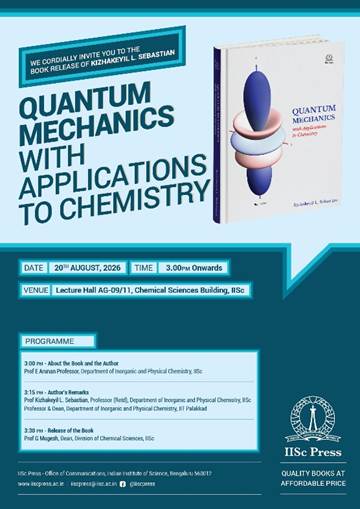
A very good afternoon to everyone gathered here on this important occasion to release the book authored by Prof. Kizhakeyil L. Sebastian, KLS to many of us. He has titled the book: Quantum Mechanics with Applications to Chemistry. I am very pleased and feel privileged to have an opportunity to speak about the author and the book today.
Prof. Sebastian has been an outstanding teacher and researcher. I am very glad that he made the efforts to write this book. Let me give a brief introduction to the Author before talking about the book. Prof. Sebastian was born in Kerala in 1950. His first name, Kizhakeyil would be his house name, I think. It may have been in Thrikkakara at Ernakulam in Kerala. [1] The second letter ‘zh’ is unique to Tamil (Thamizh) and Malayalam, which is his mother tongue. I have heard about this sound being used in Marati as well. He did his B. Sc. from the Kerala University in 1970 and MSc from Calicut University in Kerala in 1972. The same year, he came to this Department of Inorganic and Physical Chemistry (IPC) at the Indian Institute of Science (IISc) and completed his Ph. D. in about three years working with Prof. A. K. Chandra. Incidentally, Prof. Chandra wrote a book titled Introductory Quantum Chemistry in 1974 and KLS must have been in the group at this time. Those days, it used to take several months to a year to have the Thesis evaluated by national and international experts and he got his degree in 1976. During this period, he worked with Prof. S. K. Rangarajan who had joined our Department in 1975. SKR as we call him fondly turned out to be a major influence on KLS. For those who do not know, Prof. Rangarajan may have been the only one to become a Professor in IISc who did not have a Ph. D. He had done BA in Maths. He did train many Ph. D. students in our Department. When we joined the Department, SKR returned to Bangalore from Central Electrochemical Research Institute in Karaikudi, where he served as Director. We invited him to come to the Department regularly and gave him an office. As the Chair of this Department a few years ago, I had invited Prof. Sebastian to come back to IPC and be with us. SKR and KLS are great colleagues with whom one could discuss about any topic in Science. They were both very generous with their time and in sharing their knowledge. KLS wrote a moving obituary of SKR and anyone interested may read it. [2]
Prof. Sebastian seems to have had no ‘break’ all his life. From 1976-84, he served as a Lecturer in Calicut University, soon after completing his Ph. D. In 1984, he was promoted to the Reader position at Calicut and in the same year, moved to University of Cochin as Professor. During his tenure at Calicut University, he went to do post-doctoral research at the University of Liverpool, UK from 1980-82 and Chalmers Institute of Technology, Sweden in 1982. The following year, he went to the University of Munich as an Alexander van Humboldt Fellow to work with Prof. Gerhard Ertl, who won the Nobel prize for developing the mechanism of Habor-Bosch Process producing ammonia from the very inert nitrogen gas. Sebastian served as a Professor in the University of Cochin for 12 years teaching physical chemistry and quantum mechanics in particular. He was working with research students and publishing high-quality papers in not so high impact Journals. He was elected a Fellow of the Indian Academy of Sciences in 1994 and got the coveted SS Bhatnagar Prize in Chemical Sciences in 1995. The next year, IPC Department invited him to be a Professor. Getting into IISc, either as a student or faculty is not easy. In our Department, getting in as faculty after doing Ph.D. in our Department is near impossible, particularly after 1980s. Moving from a state University to IISc is indeed exceptional. KLS did all these extraordinary things. To my knowledge, Prof. Kishore, who was the Chair when I joined, came from Gorakhpur University and Sebastian came from Cochin. In the foreword of the book, KLS says ‘the years I spent at IISc were the best years in my life’. I joined IPC is 1997 and I am glad to have had a nearly complete overlap with him in our Department. His presence in IPC certainly helped me and I suspect it helped many of my colleagues in the Department / Division and the Institute.
Not surprisingly, he was a member of the Centre for Condensed Matter theory in IISc and also a member of the Condensed Matter Theory Unit at the Jawaharlal Nehru Centre for Advanced Scientific Research (JNCASR) in Bangalore. He also had visiting positions at the Max Planck Institute for Polymer Research, Mainz, Germany; University of Milan-Bicocca, Asian Institute of Nanobiosciences, Pusan, Korea and at the National Institute for Advanced Industrial Science and Technology at Tsukuba, Japan. He served our Department as Chair from 2005-08 and the Science Education Panel of the Academies from 2015-17. He also served as the Vice-President of the Indian Academy of Sciences from 2016-18. He has served in the board of education in several Universities and selection committee in several IITs. More importantly, he was the Chief Editor for Resonance, Journal of Education from 2012-14 after serving in the editorial board from 2002. He had written several articles in Resonance. I wrote a few articles in Resonance as well during this period.
In 2011, IISc started the undergraduate program in sciences after a century of existence without one. We were lucky to have Sebastian in our faculty, and he was the obvious choice to teach the first semester course in chemistry dealing with the physical principles of chemistry. His course was very popular. Some years earlier, Prof. Mangala Sunder Krishnan spearheaded the National Program on Technology Enhanced Learning, popularly known as NPTEL [3]. Sunder had spent two semesters on sabbatical in our Department. He convinced Sebastian to give lectures on quantum mechanics. KLS did not like to give lectures sitting in a chair with the laptop on a desk, as it was done in IISc those days. He preferred a lecture hall with students in front and Sunder arranged this in IIT Madras. KLS went there every weekend and recorded 12 lectures on Saturday and Sunday. His NPTEL course is available on YouTube [4]. I noted on 19 August 2026 that the lectures have been listened to 2.4 Lakh times.
I have listened to Sebastian numerous times in various places and occasions. He could explain even the most difficult concepts in a way everyone in the audience can learn. The popularity of his lectures for the NPTEL course convinced him to write this book being released today. He remembered to thank Prof. Mangala Sunder Krishnan in the foreword. When I was asked to speak about the author and book in this function, I readily agreed, though I did feel we have several excellent theoretical chemists who could have done this. In any case, let me share my thoughts on the book now.
Quantum Mechanics with Applications to Chemistry is not the first book on this topic. However, this may be the first book on this topic, perhaps on any topic, which uses interesting cartoons throughout the book to explain difficult topics. He has used the characters found in his famous lectures and modified them, perhaps for copyright reasons. Quantum Ganithathil is the teacher of quantum mechanics. Ganitham in Malayalam is Maths and you can note the ‘il’ which also means ‘illam’ or house. Professor lives in Maths. Mathew Kudiyil is a drunkard claiming to be a Captain in the army who wants to learn quantum mechanics. Kudi is drink in Malayalam and Mathew lives in ‘drinks’. His lectures would use Professor Calculus and Captain Haddock from Tin-Tin comics and he could not get permission to use them in the book. He has four student characters in the book, best being Anita. One can see their questions, comments and the response by the teacher throughout the book in cartoons.
Prof. Sebastian used to begin his lectures on quantum mechanics with two photos. One of dracula and another of Aiswarya Roy, a beautiful actress in India who won the Miss World in 1994. He would say some students think of a dracula when thinking about quantum mechanics, feeling scarred. He himself thought quantum mechanics is beautiful, like Aiswarya Roy. For the book, he has created a beautiful Indian actress using AI. As I was going through the book, I remembered the book with the same title written by Pauling and Wilson published in 1935, nearly 90 years ago [5]. That book was published very soon after all the major discoveries happened in quantum mechanics from 1925-30. Prof. A. K. Chandra’s book is titled somewhat similarly, Introductory Quantum Chemistry, published in 1976, fifty years ago [6]. Clearly Sebastian’s book includes topics that could not have been covered by the previous books. Chapters on density functional theory and computational chemistry are new. Pauling and Wilson’s book starts with a chapter on classical mechanics and one on ‘old quantum theory’ including Bohr’s model of hydrogen atom. Chandra and Sebastian do not allocate a chapter for these initial developments and focus on quantum mechanics as well established after 1925.
Sebastian begins his book with the two slit experiment and acknowledges Feynmann for this. The wave-particle duality is best explained by this experiment which has been done with electrons initially and more recently with C60, fullerene. I have been fortunate to listen to his lectures on this and I am sure all the readers of this book will get hooked to it right away. The book mentions about Einstein’s dilemma and his famous quote ‘God does not play dice’ Chandra also began his book with waves and quanta. Pauling and Wilson have 15 Chapters and except for the first two, one can see that Sebastian has covered and updated all the topics. Chandra’s book has only 9 chapters and the first 8 are covered in Sebastian’s book. The ninth chapter in Chandra’s book discussed Hellman-Feynman theorem and its applications in Chemistry. This is something I have not learned myself and I hope Sebastian includes this when he plans the second edition.
Another topic that is missing is the developments based on electron density topology, Bader’s Atoms in Molecule: A quantum theory [7] and Erin Johnson et al.’s Non-covalent Index analysis [8]. These have proven useful for understanding structure and bonding in small molecules and supramolecules as well. Of course, I am aware that Prof. Sebastian is not appreciative of AIM theory, and he has Prof. Roald Hoffman, another Nobel laureate sharing similar views [9]. Almost 20 years ago, I wanted to use AIM theory and it was difficult for me to read the papers and books and grasp them. I was lucky to have KLS as a colleague. I asked him to read and give some lectures which he readily agreed. I did learn about AIM theory and the fact that Sebastian is not impressed with it. Our group has since used AIM theory and recently NCI, extensively. My only response to KLS about AIM theory was that we should use experiments and theoretical models available to us and be aware of their limitations before drawing any conclusions. All experiments and models have something to teach us. More data and less interpretation lead to good science, less data and more interpretation lead to wrong conclusions.
Due mostly to his health conditions, Prof. Sebastian could not come back and stay with us in the Department after his term as Dean at IIT Palakkad came to an end in 2021. While we missed him dearly, we are very pleased that he has taken the time and put in a lot of efforts to complete this book. I am sure this would remain useful for students and researchers for generations to come. He does worry about the effect of AI and wonders if books would become obsolete. I have no doubts books such as this will remain an invaluable source. I would encourage everyone interested in learning quantum mechanics, and its applications to chemistry, to get your copy and read it. Those interested may contact IISc Press. Thank you, Sebastian, for writing it.
References:
- https://fellows.ias.ac.in/profile/v/FL1994021 (Accessed on 20 August 2026)
- https://ipc.iisc.ac.in/~kls/skr-1.htm (Accessed on 20 August 2026)
- https://nptel.ac.in/ (Accessed on 20 August 2026)
- https://www.youtube.com/watch?v=Yf_4Qv-A55Q&t=14 (Accessed on 20 August 2026)
- L. Pauling and E. B. Wilson, Introduction to Quantum Mechanics with Applications to Chemistry, The McGraw-Hill, New York (1935) Dover Edition (1985).
- A. K. Chandra, Introductory Quantum Chemistry, Tata McGraw-Hill, New Delhi (1974).
- R. F. W. Bader, Atoms in Molecules: A Quantum Theory, Oxford University Press (1990).
- E. R. Johnson et al. “Revealing Non-covalent Interactions”, J. Am. Chem. Soc. 132, 6498-6506 (2010).
- S. Shaik, H. S. Rzepa, and R. Hoffman, “One molecule, two atoms, three views and four bonds” Angew Chemie. Int Ed. Engl 52, 3020-3033 (2013).
(Reference 9 is an interesting read for those interested in Chemical Bonding. It records the conversation between three theoretical chemists. An excerpt follows:
Roald: … … and got widely different results. I like to show these to people who claim there is a good way to define a bond. Of course they’ll tell me that I should do a QTAIM analysis.
Sason: Better define that.
Henry: Quantum Theory of Atoms and Molecules, QTAIM, a method based on the topology of the electron density ρ,[14] has its uses.
Roald: I was saying that tongue-in-cheek, Henry. I am no great fan of QTAIM – in the hundreds of QTAIM papers that crowd the literature, I have yet to see one that makes a chemical prediction, or suggests an experiment.
Somewhat coincidentally, the same issue has an article co-authored by me. E. Arunan, R. Brakaspathy, G. R. Desiraju, S. Sivaram, Chemistry in India, Angew. Chemie Int. Ed. Engl. 2012, 51.)
 earunan